


Traditional Chinese Medicine treatment approaches for foot pain
Photo Cred: Dương Nhân/Pexels
By Melissa Carr, BSc, DrTCM
This time of year, I see many patients struggling with foot pain. After months of sandals, increased activity and time outside, and summer heat that may cause swelling, it’s not uncommon to see an influx of patients who have been dragging their feet from getting treatment as the summer months fade away.
While conventional approaches like custom footwear and shoe orthotics can be helpful, Traditional Chinese Medicine (TCM) offers a unique approach.
As always in TCM, we need to assess each patient individually to come up with a TCM diagnosis, even if the patient already has a Western medicine diagnosis like plantar fasciitis, gout, or Morton’s neuroma.
Half of the main acupuncture channels—Liver, Gallbladder, Kidney, Urinary Bladder, Spleen, and Stomach—start or end at the feet. Therefore, checking an acupuncture chart to match up the foot pain location with the channel(s) that pass through the area offers a starting point to diagnosis.
Pain at the big toe that has been diagnosed as gout, for example, would indicate potential imbalances with the Liver or Spleen. A stress fracture at the fifth metatarsal bone would impact the Urinary Bladder or Gallbladder channels. Heel pain caused by plantar fasciitis is a bit trickier to pick out from a chart, as there is no meridian acupuncture point at the bottom of the heel. However, because the Kidney channel is the only one that has a point on the sole of the foot, within the plantar fascia, it is involved. Additionally, I often find my patients have very tight calf muscles that contribute to pulling via the Achilles tendon into the plantar fascia, so the Urinary Bladder channel may also need to be addressed.
Many kinds of foot pain may be associated with internal health conditions, and are as important to assess. Though the patient may come in solely seeking treatment for their foot pain, if they also have digestive disorders, a chronic inflammatory disease, or insomnia, those issues need to be treated for a more complete recovery.
For instance, someone with gout who experiences fatigue, foggy-headedness, bloating, loose stools, and tendency to overthink is displaying signs of Spleen Qi deficiency. On the other hand, another gout sufferer who instead has hormonal migraines, red eyes, and feels irritable has Liver Qi stagnation and Heat. If they also have acid reflux, constant hunger, nausea, and acne, Stomach Fire must also be treated to address potential root causes to the foot pain.
Acupuncture for Foot Pain
There are many official acupuncture channel points to treat foot pain locally. In addition, ashi (translated as “ah, yes”) points, are tender points where acupuncture needles can be placed.
For pain in the toes, I often choose the extraordinary points (acupuncture points that are documented but not connected directly to the channels), ba feng, which are situated on the dorsum of the foot, between the toes, about half a thumb width proximal to the margin of the web.
In addition to choosing local acupuncture points, xi cleft points are often used to treat pain, while hui meeting points relate to specific types of tissue. Furthermore, TCM organs are connected to the body tissues as well.
If the pain is related to the bones, such as for osteoarthritis or a stress fracture, some Kidney channel points like Kidney 3 (tai xi) for Kidney deficiency or Kidney 6 (zhao hai) if there is Kidney Yin deficiency could be chosen. Kidney 5 (shui quan) is the xi cleft point for the Kidney channel and Gallbladder 39 (xuan zhong) is the hui meeting point for marrow.
For tendon or ligament pain, like tendonitis or sprains, treat Liver channel points like Liver 3 (tai chong) for Liver Qi stagnation, Liver 2 (xing jian) for Liver Fire, or Liver 8 (qu quan) for Liver Blood deficiency. Liver 6 (Zhong du) is the xi cleft point and Gallbladder 34 (yang ling quan) is the hui meeting point for the tendons and ligaments.
Pain related to the muscles of the feet can be addressed through the Spleen channel points, including Spleen 3 (tai bai), Spleen 4 (gong sun), or Spleen 6 (san yin jiao) for Spleen Qi deficiency. Spleen 10 (xue hai) moves the Blood, improving circulation, while Spleen 8 (di ji) is the xi cleft point of this channel.
The Kidney channel is the only one to have a point on the sole of the foot: Kidney 1 (yong quan). This point sits between the second and third metatarsal bones, about a third of the way between the base of the second toe and the heel, in a depression that can be felt when the foot is plantar flexed. It’s often tender when pressed. While I rarely acupuncture this point, it is also said to help calm the nervous system and it may help with pain on the sole of the foot like that caused by plantar fasciitis or Morton’s neuroma.
Herbs for Foot Pain
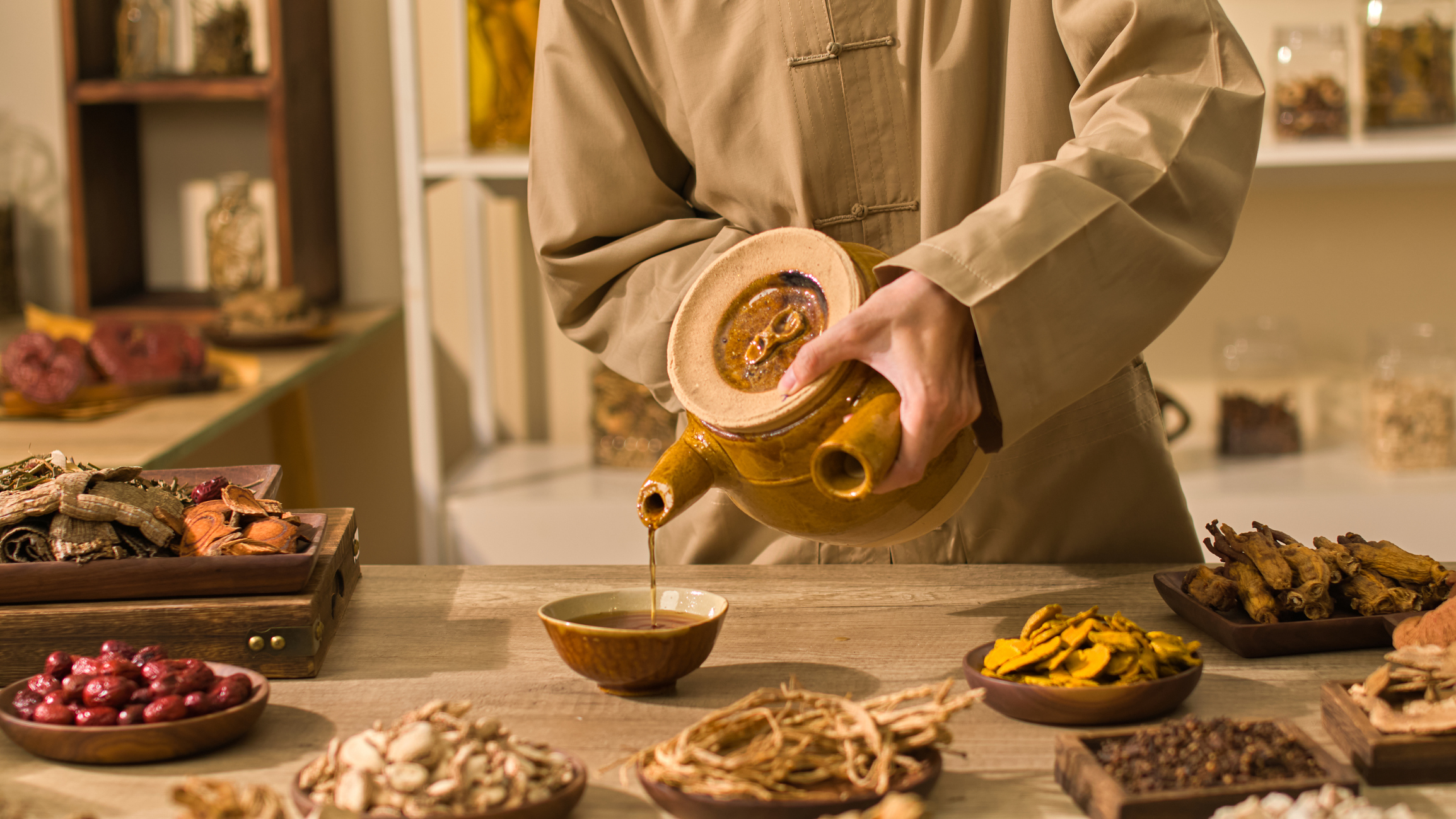
Most natural health practitioners know about the anti-inflammatory benefits of turmeric. TCM uses three forms of turmeric, called e zhu, yu jin, and jiang huang, each with slightly different properties, but all are used to treat pain. Yan hu suo and chuan lian zi are commonly combined as herbal painkillers, and bai shao is often employed for muscle tension, particularly if Liver Blood deficiency is part of the diagnosis.
Since some herbs in TCM also have a direction they tend to travel (up, down, inward, outward), it’s wise to include herbs that move down to the feet. Niu xi is one such herb and there are two types: chuan niu xi and huai niu xi. Both can move Blood and nourish the Liver and Kidneys to strengthen the sinews and bones.
And, since the feet are attached to a person, it’s also important to include herbs to address the whole individual.
Feet are the Foundation
For my patients, even those without any foot pain, I recommend strengthening the feet with exercises, practice balancing, and acupressure massage. After all, painful feet make it hard to go about a normal day, preventing people from exercising or sometimes keeping them from doing their job.
About the Author: CJ Weber

Also on Integrative Practitioner
Measuring Biology vs. Symptomatology: The Fully Integrated Functional Wellness Program
Non-Member Price: $30.00 Member Price: $18.00 – 40% Off for Members Only Add to Cart Presented by: Dane Donohue, DC...

Integrative and Comprehensive Approach to Inflammatory Bowel Disease
Non-Member Price: $30.00 Member Price: $18.00 – 40% Off for Members Only Add to Cart Presented by: Ronald Hoffman, MD,...

Dental Danger: Signs of Sleep Breathing Disorders in children and Adults, Learn the Visual Clues
Non-Member Price: $30.00 Member Price: $18.00 – 40% Off for Members Only Add to Cart Presented by: Mark Breiner, DDS,...

Dietary Needs of the Cognitively Impaired
Non-Member Price: $30.00 Member Price: $18.00 – 40% Off for Members Only Add to Cart Presented by: Laura Rokosz, PhD...
Lifestyle Choices Chart Your Brains Destiny
Non-Member Price: $30.00 Member Price: $18.00 – 40% Off for Members Only Add to Cart Presented by: David Perlmutter, MD,...