








The Breathtaking New Cure for Chronic Insomniacs
Contributed Commentary by Barry Krakow, MD
October 22, 2026 | Chronic insomnia (difficulty falling asleep or staying asleep) is a devilishly tricky condition to treat, and for millions cures remain elusive. Thirty years ago, as a recently board-certified sleep medicine specialist, I uncovered a cure for insomnia buried in the scientific literature since 1973. To this day, the cure remains hidden to nearly all healthcare professionals and their chronic insomnia patients.
My journey started in 1988, entering the field of sleep medicine via psychiatry research with Robert Kellner and Joseph Neidhardt, when we developed the first non-drug treatment protocol, Imagery Rehearsal Therapy (IRT), for chronic nightmares. Eventually, my own team conducted definitive research on sexual assault survivors with posttraumatic nightmares. This landmark work, published in JAMA, 2001, was the first controlled study to prove treating a sleep disorder decreases mental health symptoms, and these patients were suffering severe nightmares, insomnia and posttraumatic stress disorder (PTSD). By mid-1990s, despite these women’s large post-treatment decreases in nightmare and PTSD severity, my sleep medicine training spotted something in their sleep, which at the time made zero sense.
Serendipitously, I had a run-in with this 1973 insomnia research gem, smacking me in the face, as I describe in a brief oral history, 2017 TEDx talk, entitled “Why do you wake up at night?” Then, in Biological Psychiatry (2001) we published the first peer-reviewed article to examine a cohort of PTSD patients with insomnia, and 90% showed objective evidence confirming this missing link, the link that led to curing my insomnia and the identical link discovered by Dr. Christian Guilleminault in his seminal 1973 research study.
What was the missing link? Here’s a clue: it’s not mental, it’s physical; and, it makes no sense. Insomnia is a psychological sleep disorder, or at least everyone thought so. Why would something physical cause it? How could something physical affect so many different individuals in nearly indistinguishable ways to produce chronic sleeplessness, and why were healthcare professionals, especially mental health professionals, oblivious to this relatively ancient research?
Let me share Susan’s 30-year search for a cure to show you the how and the why.
When Susan visited our sleep center at age 47, she was desperate, in tears, and she declared, “this is my last shot!”
In high school, she first noticed test anxiety keeping her up at night, and the problem intensified in community college. With marriage and two small girls interrupting her education, frequent bouts of sleep deprivation nullified any hint of sleeplessness. Once the girls went to school, she started as a full-time admin assistant at a daycare, and insomnia reemerged with difficulties falling asleep most nights coupled with frequent nighttime awakenings. Her initial visit to a primary doctor yielded an Ambien prescription with directions on short-term use. Two years later, Ambien was taken five nights/week, but she drank beer or wine on weekends “so, I wouldn’t get hooked on Ambien.”
When Ambien triggered a weird sleep eating disorder, causing a 15-pound weight gain, she stopped cold turkey only to suffer severe rebound insomnia. Three days later, her husband drove her to an emergency medical center. Agitated, wild-eyed, and slightly incoherent, she yelled at the doctor, “I’m never going to sleep again.” A new sleeping pill was prescribed, but the instructions required a gradual taper within a month. Psychotherapy was encouraged for anxiety. A discharge nurse suggested a sleep center, but Susan was satisfied with her new mattress.
For another ten years, Susan started and stopped various sleeping pills, prescription and over-the-counter (OTC) sleep aids, with no lasting benefits while embarking on an endless quest for advice from friends and family as well as a hypnotherapist, massage therapist, acupuncturist, psychotherapist, psychologist, psychiatrist, chiropractor, functional/integrative medicine doctor, and an herbalist. While none solved her sleep problem, a social work psychotherapist uncovered a much earlier origin—sexual assault in 5th grade. Susan suppressed most of these memories, never realizing much of her anxiety was fueled by PTSD. Though ensuing psychological therapies were enlightening, informative and resulted in moderate decreases in anxiety, the sleeplessness persisted, which led to mixed responses to multiple attempts with sedating psychotropic medications prescribed to treat both PTSD and insomnia.
Over time, she would encounter primary care physicians, nurse practitioners and physician assistants, all hinting at sleep center evaluations (mattresses not included). One NP told her about an advanced psychological technique, cognitive-behavioral therapy for insomnia (CBT-I), but she visited two sleep centers, and none delivered CBT-I. Moreover, these sleep professionals asserted her condition was “mental,” so more therapy was recommended. No one mentioned sleep testing, because she did not suffer from snoring, obesity or daytime sleepiness.
Nearing the end of her rope, she consumed larger “dosages” of alcohol, the number one choice among many chronic insomniacs, because it’s so effective in putting someone to sleep. She was downing a six-pack of beer two hours before bedtime, but always suffered the agonizing awakenings 2 to 3 hours later, unable to return to sleep. When desperate, she drank another beer with an OTC sleep aid, unaware of the potentially fatal mix of antihistamines and alcohol.
A new internist read her the riot act on alcohol use and strongly encouraged a 12-step program; he insisted on sleep testing, but the first sleep study was negative, so he asked for a repeat, at what was now her 4th sleep center, which revealed something called, “increased spontaneous arousal activity.” However, when Susan met the board-certified sleep specialist who completed a sleep medicine fellowship training at a prestigious university, she was informed arousal activity indicated anxiety or depression, and therefore more medications and psychotherapy were prescribed. His training also did not include CBT-I.
Susan read about CBT-I and tried to restrict her sleep by spending less time in bed to improve continuity. However, sleep quality remained poor along with frequent tossing and turning and regular trips to the bathroom. She soldiered on, exhausted, worn out, depressed, irritable and worried about her memory. When asked by a new family medicine doc whether she was sleepy during the day, she replied, “No, I’m tired, I’m exhausted, I never nap.” This physician wisely referred her to our sleep center.
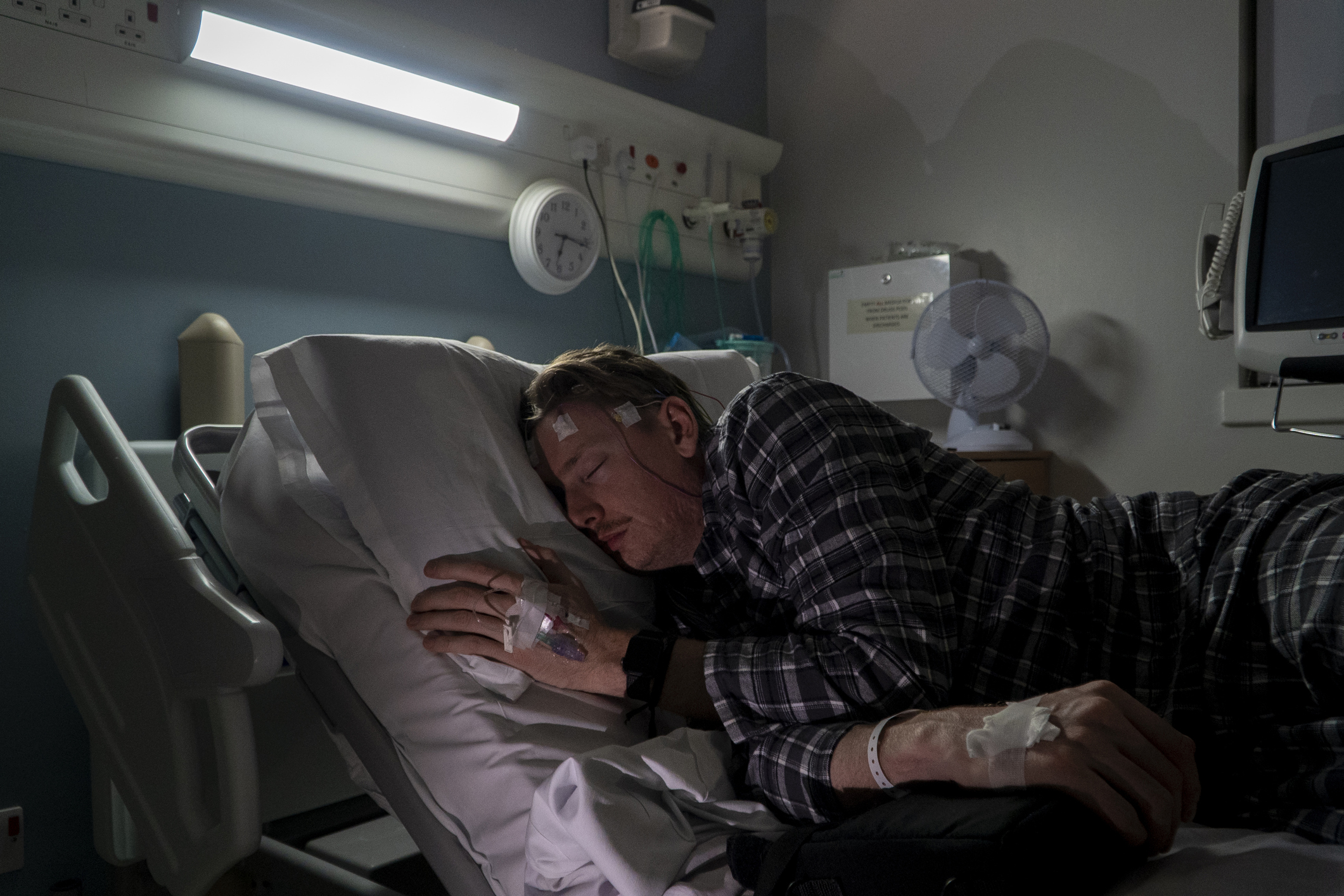
Among thousands of similar cases treated since the mid-1990s, we start with a full night diagnostic sleep laboratory test and apply advanced breathing sensors to track respiration. The next morning, the patient sits with the sleep tech in front of the same computer that captured the data.
We showed Susan her sleeping brain waves. Deep sleep displays tall, wide EEG (electro-encephalographic) rhythmical signals, whereas, fragmented sleep signals appear chaotic, short and narrow. Schematically, deep sleep’s a peaceful landscape of rolling hills; bad sleep a jagged, dense jungle. Among insomniacs, far too much time spent in jungle mode means brain waves constantly speeding up, indicating arousals (few seconds) or awakenings (>15 seconds). Susan was astonished by the scarcity of deep sleep and the severity of sleep fragmentation throughout the night.
Next, aligned beneath the brain waves, Susan is shown the breathing tracing to observe the volume of each breath. A normal breath signal appears as a line of arc shapes, that is, rounded or semi-circular curves; the space below the arc indicates a full inhaled breath. With abnormal sleep breathing, the curved shape flattens, indicating a drop in air volume. Susan was perplexed by the lack of normal rounded breaths and instead witnessed pervasive flattening (loss of the arc shape) on the tracing; perplexity turned to shock when we pointed to the link between breathing abnormalities coinciding with brain arousals and awakenings.
Simply, as her flattened breaths persisted over seconds or minutes, the brain abruptly speeds up. Then she returns to sleep and repeats the cycle every 30 to 120 seconds, or literally hundreds of episodes per night, the missing link causing chronic insomnia.
As often occurs in our 2nd (3rd, 4th, 5th) opinion cases, abnormal brain patterns were detected at a previous sleep center but misinterpreted by not linking them to breathing events. This distressingly common problem in the field of sleep medicine has led to misdiagnosis in innumerable chronic insomniacs.
Susan was staring directly at the physical cause of her insomnia, a sleep breathing disorder constantly arousing and awakening her, thwarting deeper consolidated sleep. Contrary to the psychological viewpoint pounded into her head by virtually every doctor, therapist or healthcare pro for three decades, she rapidly digested and absorbed the computer data and was both delighted and mystified by the diagnosis.
Many such patients are not so forgiving upon encountering a 30-year misdiagnosis, which was the cause of immense suffering. Many are justifiably angry they never received the proper sleep medical workup to accurately diagnose the problem. A large proportion are disgusted by and bitter about the providers who kept telling them “It’s all in your head.” The good news, following these initial common grievances, is the dramatic elation from learning about a physical and curable explanation for chronic insomnia.
Susan eagerly moved forward with positive airway pressure or PAP therapy (gold standard treatment for sleep apnea) and within weeks 80% of insomnia evaporated, and alcohol consumption decreased. Six months later, insomnia 90% improved, off alcohol, and she clearly noted enhanced memory, attention and concentration, not to mention more daytime energy, less fatigue and no more nighttime pit stops. Her family was a lot happier as well.
The kicker is that ordinary CPAP doesn’t work well in chronic insomniacs. Our landmark research, published in the Lancet journal EClinical Medicine, compared CPAP to a more advanced device known as ASV or adaptive servo-ventilation. ASV yields markedly greater improvements in insomnia, nearly three times the rate of success compared to conventional CPAP users. Susan’s response was rapid, because she easily initiated ASV therapy and was not forced to waste time and effort attempting CPAP. Regrettably, most sleep doctors don’t appreciate how CPAP triggers an anxiety response in these complex patients, who often quit use and never return for care.
Susan is not an isolated case. Thousands of insomniacs we’ve treated, many even more complicated, received instructions emphasizing various psychotherapies and/or multiple psychotropic drugs along with sleeping pills instead of receiving a referral to a sleep center. Likewise, many visited sleep doctors who missed the diagnosis or prescribed CPAP, leading to frustrating or traumatizing experiences without corresponding benefits.
Having researched and published on these cases for more than a quarter century and repeatedly observing extraordinary rates of sleep breathing disorders in chronic insomniacs, apparently it remains so invisible to patients and professionals alike, suspicions for a physical sleep disorder remain buried under the covers.
In stark contrast, we sincerely believe properly testing patients and prescribing ASV PAP therapy will profoundly change treatment options for chronic insomniacs (and their doctors and therapists) in ways far beyond what has ever been imagined. For millions who suffer intensely demoralizing, fitful sleep along with the exasperation from wasting valuable time, effort, and resources pursuing misinformed treatments, there is a real cure, truly breathtaking in scope, to end your sleepless nights.
Barry Krakow, MD is a board-certified internist and sleep medicine specialist, with nearly four decades of research studies on the complex relationships between sleep and mental health. One of his earliest discoveries showed that sleep breathing disorders are extremely common in trauma survivors suffering from chronic PTSD. His ground-breaking book, Life Saving Sleep: New Horizons in Mental Health Treatment, guides both patients and healthcare professionals in learning how to use sleep treatments to improve brain function and mental health. He currently lives in Savannah Georgia and provides sleep health coaching services at www.barrykrakowmd.com. He also writes at www.fastasleep.substack.com. He can be reached at [email protected].
About the Author: Allison Proffitt

Also on Integrative Practitioner

Music Therapy Proves Effective for Post-Treatment Cancer Survivors
By Lauren Kells October 20, 2026 | Although cognitive behavioral therapy (CBT) has long helped cancer patients manage anxiety and...

Should Peptide Scientists Ignore the Peptide Craze?
By Judy Myers October 14, 2026 | Unregulated injectable peptides promising better aging, better healing, and better sex are being consumed...

Exercise’s Impact on Cognition, Molecular Aging
By Allison Proffitt October 8, 2026 | Exercise didn’t sharpen thinking in breast cancer survivors, but it may have slowed...

Sugar May Supercharge Antibiotic Gut Damage Hospital Study Suggests
By Allison Proffitt October 6, 2026 | Cutting back on sweets while taking antibiotics could help protect the gut’s bacterial...

Follow the Money: Nasal Microbiome, Women’s Wellness
By Integrative Practitioner Staff September 30, 2026 | Funding news from around the wellness space including investments in microbiome testing,...