







LinusBio’s Traced Uses Hair to Build a Molecular Record of Environmental Exposures
By Allison Proffitt
September 8, 2026 | LinusBio is delving into the exposome with Traced, a new hair testing tool designed to give consumers a month-long view of their exposure to a panel of elements rather than the single-point measurements typical of conventional health testing.
Manish Aurora, founder and CEO of LinusBio, describes Traced as an environmental “sentinel system,” using hair as a biological record of what has been happening inside the body over time. Unlike conventional hair mineral tests that may digest hundreds of strands to deliver a single measurement, Traced analyzes hair along its length, allowing LinusBio to reconstruct a time-based exposure profile dating back about a month.
“The amazing thing about hair is that it’s this molecular movie instead of a snapshot,” Arora told Integrative Practitioner. “It actually gives you a daily profile at the molecular level.” Arora is also a professor and vice chairman of environmental medicine and public health at the Icahn School of Medicine at Mount Sinai and has spent two decades developing the technology underlying the company’s platform.
Turning Hair Into A Timeline
The mechanical sampling behind Traced is the same as LinusBio’s previously-released autism spectrum disorder test. Hair grows an average of 1.25 cm per month, so testing along the length of the hair samples different time points.
LinusBio says its technology measures approximately 10,000 molecules at each growth point and can analyze up to 1,000 time points, producing what Arora characterized as roughly 10 million original data points from a single sample.
That longitudinal aspect is central to the company’s approach. Conventional blood testing, for example, provides information about what is happening at the time the sample is collected. Traced instead attempts to show how an exposure has changed over a period of weeks. Arora compares the approach to a wearable device, but one that is collecting information continuously at the molecular level without requiring the user to wear or charge anything.
Separating Internal Exposure From Contamination
One of the major technical challenges in using hair for environmental testing is distinguishing substances incorporated into the hair from anything that has accumulated on the hair’s surface. Hair is exposed to the surrounding environment and can collect pollutants, smoke, and other substances. Conventional hair analysis can therefore confuse external contamination with biological information.
Traced addresses that problem by processing the hair lengthwise rather than simply cutting or pulverizing it. According to Arora, LinusBio has developed robotic technology capable of straightening and opening individual hairs, including curly hair, without applying heat. A laser is then used to access the microscopic central core of the hair. Arora says this core contains information incorporated through the body’s blood supply and is less susceptible to contamination from the outside environment.
The process is highly automated, Arora said, because maintaining the precise alignment required for laser analysis is difficult to accomplish manually. LinusBio spent years developing the robotic process, including methods for handling different hair types and textures.
Mass Spectrometry and an Expanding Panel
The first (and current) version of Traced includes 15 elements broken down on a Traced report into essential elements such as zinc and copper, toxic metals including lead, aluminum, arsenic and cadmium, and other elements that can occur in the body, such as strontium and lithium. Arora said future versions of Traced are expected to incorporate pesticides, PFAS or “forever chemicals,” compounds associated with microplastics and other environmental substances. The company also expects to add mercury to the panel in a future update.
“We have started with elements, but we have a plan to keep adding what we call organic as well,” he said.
A Global Reference Database
Traced does not simply report concentrations without context. The platform compares an individual’s measurements against a proprietary reference database developed by LinusBio. Arora said the database incorporates samples from different geographic regions, including the United States, Japan, Sweden, and Mexico. The population includes men and women ranging from newborns to older adults, as well as people from both urban and rural environments.
The geographic diversity is deliberate. Arora said the company found meaningful differences in exposure patterns among populations, particularly in areas affected by different environmental conditions. Rather than comparing an individual only with people living in the same community, Traced uses a global reference framework intended to prevent a population-wide exposure from appearing normal simply because everyone in a particular location has similarly elevated levels.
For instance, one community in Mexico had notably high levels of lithium. “If I just compare that community in Mexico to itself, some person will get the answer that, well, I’m low compared to my neighbors,” Arora said. “But the reality is compared to the species, you are super high.”
The database content is not publicly available, but Arora said LinusBio is working toward publishing aggregate information describing the reference population and the methodology behind the Traced report. Arora said the company is also preparing a publication describing the report and analytical methods.
From Measurements To A Consumer-Facing Score
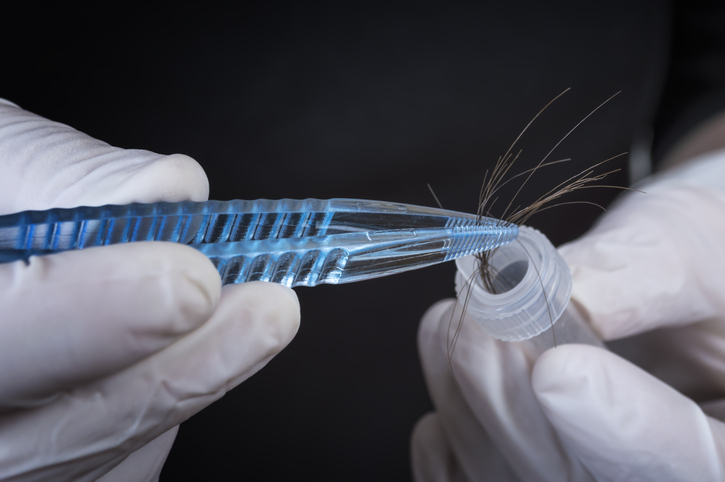
Starting a Traced test begins with ordering the test online. When the package arrives at your door, it includes a plastic test tube with a screw cap for your hair, a label, and an envelope to mail the tube back. There are no reagents, nothing to mix, nothing to swab. Simply cut 5 clean hairs as close to the scalp as possible, coax them into the tube, and return the sample via the pre-paid UPS envelope.
LinusBio requests that you wait at least a month after any hair dye or chemical treatment before you send hair. And the process of ordering and returning the test takes 10-15 days. Your results are emailed to you and the findings are mapped onto a day-by-day timeline—with an error bar of plus or minus 7 days. Arora says this is, in part, because LinusBio has no way of knowing how close to the scalp the hair was cut and your particular rate of hair growth.
LinusBio uses mass spectrometry as the primary analytical technology, the “gold standard” for identifying and quantifying molecules. The company converts the underlying measurements into an overall score on a 10-point scale, with higher scores representing a profile that is closer to the company’s desired range.
The score is accompanied by a more detailed breakdown of individual exposures. Users can see trends over the course of the month and whether measurements fall into ranges characterized by the platform as low, medium, or high.
The objective, according to Arora, is not simply to identify an abnormal measurement but to provide information that can prompt users to investigate possible sources in their everyday environment, which could include diet, supplements, cookware, household dust, water or other potential sources of exposure.
LinusBio positions Traced as a wellness and exposure-management tool rather than a conventional diagnostic test. The company says the report is not intended to diagnose disease or replace medical care. Instead, an unusual or persistent result can provide a question for a consumer to take to a physician or other healthcare professional. Arora compared that role to a screening test: a signal does not necessarily establish that something is wrong, but it can indicate that further investigation may be worthwhile.
Designed For Repeat Testing
LinusBio envisions Traced as a recurring service rather than a one-time test. Because hair provides a historical record, repeat testing could allow users to determine whether changes in their environment or behavior correspond with changes in their exposure profile.
“If we find something, we want to help you improve that to your maximum point of health and then help maintain it,” Arora said.
That could mean identifying a potential source of a high result and changing an environmental or lifestyle factor and then testing again several months later to see whether the pattern has changed.
A single test is priced at $299 and a quarterly subscription drops the price to $239. The company expects users to test several times a year, creating a longitudinal record rather than relying on a single month’s measurement. Arora describes LinusBio as a long-term partner in monitoring an individual’s environmental health. Just like your cardiovascular health may be supported by a monthly gym membership, keeping track of your exposome will be enabled by a regular cadence of testing.
“We are your environmental exposure gym,” he quipped.
A Broader Exposomics Platform
Traced represents an expansion of LinusBio’s technology beyond its work in disease-focused testing. Arora characterized the company’s overall platform as non-genomic and “exposomic,” emphasizing measurements of environmental factors rather than genetic information. The long-term objective is to use environmental measurements to fill a gap between the exposures people encounter every day and the relatively limited amount of environmental information currently incorporated into routine health monitoring.
“I really believe that this can help people improve their health far more than genetics could for the average person,” Arora said. “Genetics help when you have cancer or there’s a COVID pandemic, but those are tiny fractions of our life.”
The company expects to introduce additional exposure-related products. Arora said LinusBio is working on a product that could measure outdoor exposures without relying on hair, as well as a future hair-based test related to ALS.
“We’re exposed to so many things, but all we measure in our household is temperature through our thermostat and the fire alarm,” Arora said.
Traced is intended to provide another layer of that picture: a biological record of environmental exposure that can be collected passively, analyzed retrospectively and followed over time.
About the Author: Allison Proffitt

Also on Integrative Practitioner

Follow the Money: Nasal Microbiome, Women’s Wellness
By Integrative Practitioner Staff September 30, 2026 | Funding news from around the wellness space including investments in microbiome testing,...

Ozone Therapy in Integrative Healthcare
Contributed Commentary by Deanna Joy Gilmore September 17, 2026 | When you hear the word “ozone”, you may think of...

A 1970s Lipid-Lowering Compound May Offer a New Approach to Obesity
Obesity can cause metabolic conditions, including abnormal blood lipid levels, insulin resistance, and diabetes. Incretin-based drugs, such as glucagon-like peptide-1...

Patients with IBD Show Higher Risk of Psychiatric Disorders
By Irene Yeh September 11, 2026 | Evidence suggests that patients with inflammatory bowel disease (IBD), comprising Crohn’s disease (CD),...

Food as Medicine 2026: The Best and Worst of Times
By Irene Yeh May 8, 2026 | During the opening keynote panel at this week’s Food as Medicine Summit in Chicago, Rick Leach, executive...