

Tieraona Low Dog: Casting a Wide Vision of Health and Relational Medicine
By Allison Proffitt
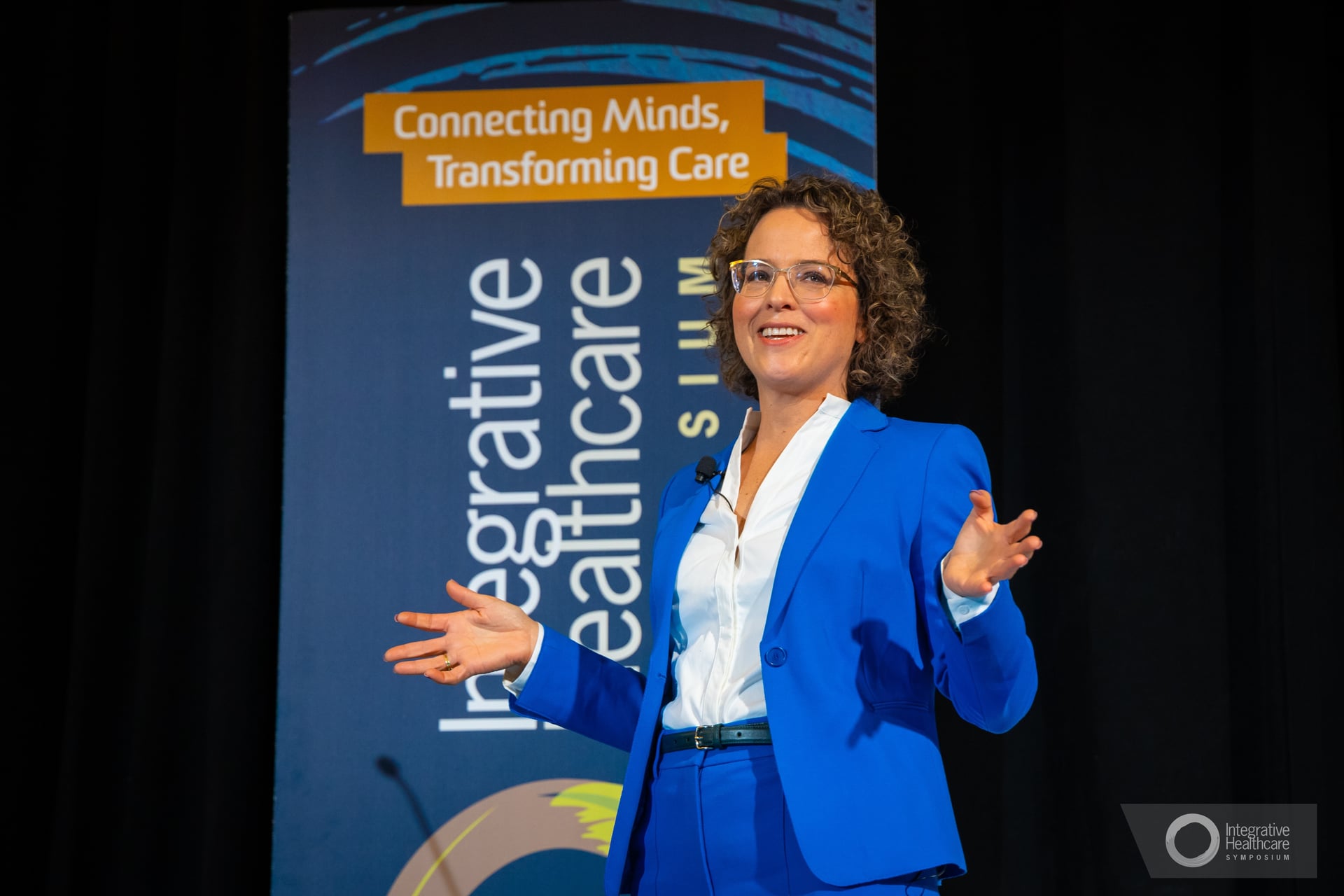
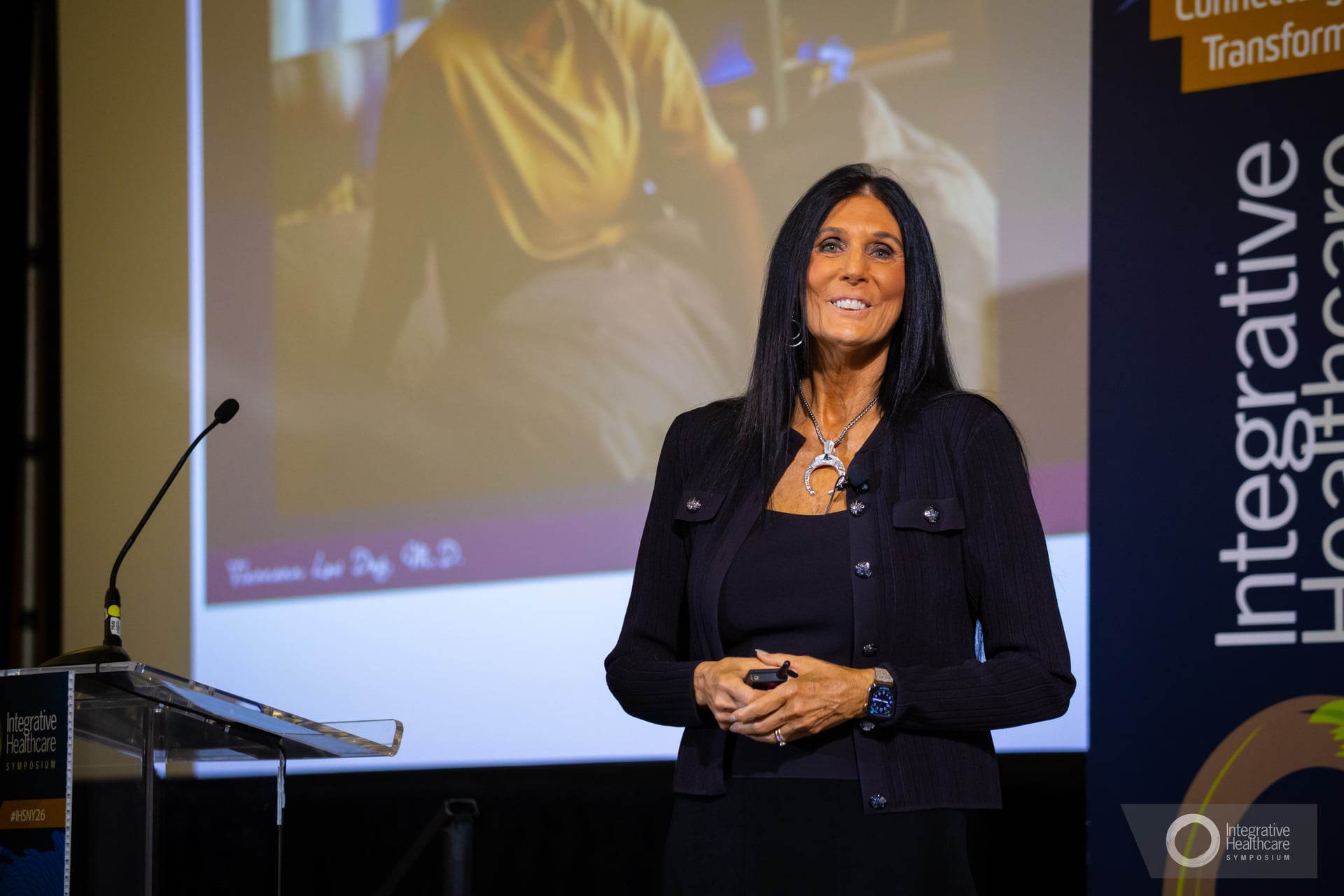
NEW YORK—In the opening keynotes of the Integrative Healthcare Symposium this week in New York, Dr. Tieraona Low Dog, Founding Director of the Integrative and Functional Medicine Fellowship at the UC Irvine Susan Samueli Integrative Health Institute, challenged the audience to look beyond modern biomedicine and pursue whole-system care, integrating traditional healing practices and being driven by curiosity.
Modern biomedicine, while valuable, uses a framework too narrow to evaluate integrative and traditional approaches to care. Dr. Low Dog argues that the field needs to expand both its research methods and its definition of healing.
She cast a vision of a healthcare system in which patients can move between emergency medicine, primary care, acupuncture, manual medicine, counseling, and nutritional guidance as integrated threads rather than competing alternatives. “No profession and no discipline feels defensive; no profession or discipline has to win; and no patient feels fragmented.”
On Curing Versus Healing
To achieve that vision, Dr. Low Dog suggested a shift in thinking from simply eliminating disease to restoring health. “The cure is not always to heal,” she said. “When we eliminated the disease — when we got rid of the symptom or we fixed the lab — the vitality has not necessarily returned.” She described healing as “relational” and “meaning-making”: “It’s about being with someone without having to fix them.”
She illustrated the point with a personal account of dislocating her hip while traveling. During a prolonged and painful emergency room visit she described looking across the room at a colleague who, rather than offering anxious assistance, simply sat with her in silence.
“He just sat with me,” she said, “and allowed people to do what they needed to do. And I felt things shift in me. My body softened, and my breath deepened, and I began to realize that the healing was already happening before I fixed my hip.” She posed the question directly to the audience: “What is that? How do you define it? How do you capture it? How do you study it? … We can fix what we can measure, but we cannot heal what was essential.”
Multidimensional Evidence and Research Methods
Dr. Low Dog does not oppose science, she just advocates for a nuanced understanding of what it can and can not accomplish. “I do not want to reduce rigor. I want science, and I want evidence,” she said. “But I want more dimensional science; I want more dimensional evidence.” Her concern is the mismatch between the randomized clinical trial model — developed for testing of pharmaceutical compounds in controlled, homogeneous populations — and the complexity of whole-system, integrative interventions.
She gave a concrete example: a researcher friend at Columbia University conducting a black cohosh study interviewed 2,000 women but enrolled only 82 after eligibility screening. Those other 1,900 women, Dr. Low Dog highlighted, represent the real women in her clinic. “How generalizable is your study if it has to be such a pristine population that they don’t even represent the patients in our office anymore?”
She distinguished the goals of science from those of medicine: “Science is about control, objective, and being reproducible … Science gets at general truths … Medicine values wisdom, compassion, empathy. I practice the art of medicine and I use science as a tool.”
“I don’t believe my listening is any less powerful than my drug. I don’t believe that my presence is any less scientific than the procedure.”
Outcomes that Matter
Dr. Low Dog argued that traditional healing systems — she listedTraditional Chinese Medicine, Ayurveda, Arabic medicine, and indigenous traditions of North and South America — are routinely dismissed in Western medicine as mere “folk practices.” She called that posture “really, really arrogant and uninformed.”
“These were not random folk practices,” she said. “They were empirical, observational, communal ways of addressing illness that evolved from generation to generation to generation over thousands of years.” And these approaches deliver outcomes that matter to the patient and the community: restoring hope and bringing harmony within the community.
She advocated for humility and curiosity when engaging with patients. She recounted a obstetric experience in which a Vietnamese patient who had delivered by cesarean section declined to shower before discharge. Rather than insisting, Dr. Low Dog asked about it through a translator and learned the patient believed that water and cold after blood loss were harmful. “That makes perfect sense,” she told the patient. “Thank you for teaching me that.”
But scientific outcomes don’t always align with the patient’s priorities. She said healthcare often mistakes a normalized biomarker for a healed person, and called for outcome measures that reflect patient experience.
“Patients never say to me, ‘Well, my biomarker’s better.’ [They say,] ‘I feel more energy. I slept better … I’m beginning to imagine my future again. I feel joy.’ Those are not soft outcomes. Those are human outcomes.”
She pointed to integrative oncology as a field beginning to do this kind of mixed-methods work, combining tumor response data with measures of fatigue, sleep, energy, and immune markers. “When you can study coherence, you begin to study true healing,” she said.
Dr. Low Dog closed her talk—and launched the rest of the conference—with a challenge to the audience: “Please don’t ever abandon science, but don’t abandon the soul and healing, either. Bring your knowledge, bring your training, bring your cultural memory, your intuition, your heart. Be the clinician that can run labs and hold hands, interpret biomarkers and nurture dreams. Let us know that the practice of medicine is wise enough to measure what we can and humble enough to know what we can’t. Let us build a system where people say, ‘I feel seen, I feel heard, I feel whole’. That is the medicine that our world is asking for and the medicine that we can create. And it is the medicine that can heal our patients, our planet, ourselves.”
About the Author: Irene Yeh

Also on Integrative Practitioner
Ancient Mushroom, Modern Medicine: Paul Stamets Says Agarikon Mycelium May Be Key to Fighting Viral Pandemics
By Allison Proffitt Paul Stamets has spent more than four decades in the forests of the Pacific Northwest, carefully prying...
The GLP-1 Era: It’s More Than Just Weight
By Irene Yeh The healthcare industry has a weight problem—a weight bias problem, according to Ashley Koff, RD, founder of...

Geography Matters for Infant Gut Microbiome
By Integrative Practitioner Staff When it comes to the human microbiome, modern life may be out of sync with ancient biology. “Our...
Weight Loss: The Least Interesting Thing About GLP-1s
By Irene Yeh At last month’s Integrative Healthcare Symposium, GLP-1s were one of the main topics, especially regarding their impact on weight loss and obesity treatment....
Lee Hood’s Persistent Plan to Reinvent Medicine From the Ground Up
By Allison Proffitt February 26, 2026 | When Leroy Hood stepped up to the podium at last week’s Integrative Healthcare Symposium to accept the Visionary Award, he told...