





Helping patients handle stress
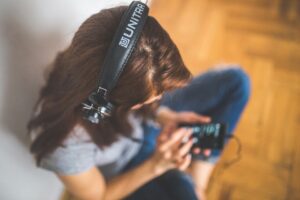
Photo Cred: Kelly Sikkema/Unsplash
By Kim Furtado, ND
As a naturopathic doctor, I listen to not only a client’s physical health needs, but their emotional and spiritual challenges. Stress is the root of many chronic illnesses, and the novel coronavirus (COVID-19) pandemic affects each of us in different, complex ways.
There are increased levels of stress and trauma experienced through the COVID-19—death of loved ones, economic decline, unemployment, potential bankruptcy, general anxiety, and overall disruption of life as we once knew. Although we are enduring a collective narrative, each person’s situation is extremely varied. How well or how poorly the basic needs of shelter, food, and hygiene are met greatly affect how overwhelmed or fearful a person becomes.
Supporting an essential worker’s needs will be an exponentially different process than someone sheltering at home with adequate food and a steady paycheck. However, despite the vast differences in what situations clients are facing at home, or at essential work, it is critical to focus on what is available to help people cope with any distress or strain they are feeling.
I find it useful to seek out a client’s strengths, and then work to introduce new skills. There is no magic formula that can allow a client to escape their inner demons, fears, insecurities, and actual threats to life and wellbeing. However, there are some very basic coping skills that can be used as a road map to reclaim peace and begin to feel centered or grounded.
The person who is coping well successfully draws on several basic skills, which include:
- Create time for self-reflection, the ability to foster a sense of awareness and feel helped by talking out a problem or situation
- Foster detachment and a sense of letting go of what one cannot control.
- Express gratitude for what is and accept life circumstances without struggle. Another skill is to trust in a higher power, or foster trust. The practice of unconditional love, or the ability to give and receive love with oneself and others is another healthy coping skill.
- Consider treating the physical body with care and compassion through personal hygiene, healthy food, and exercise.
Here is an excerpt of a worksheet I use with patients to discuss coping with stress:
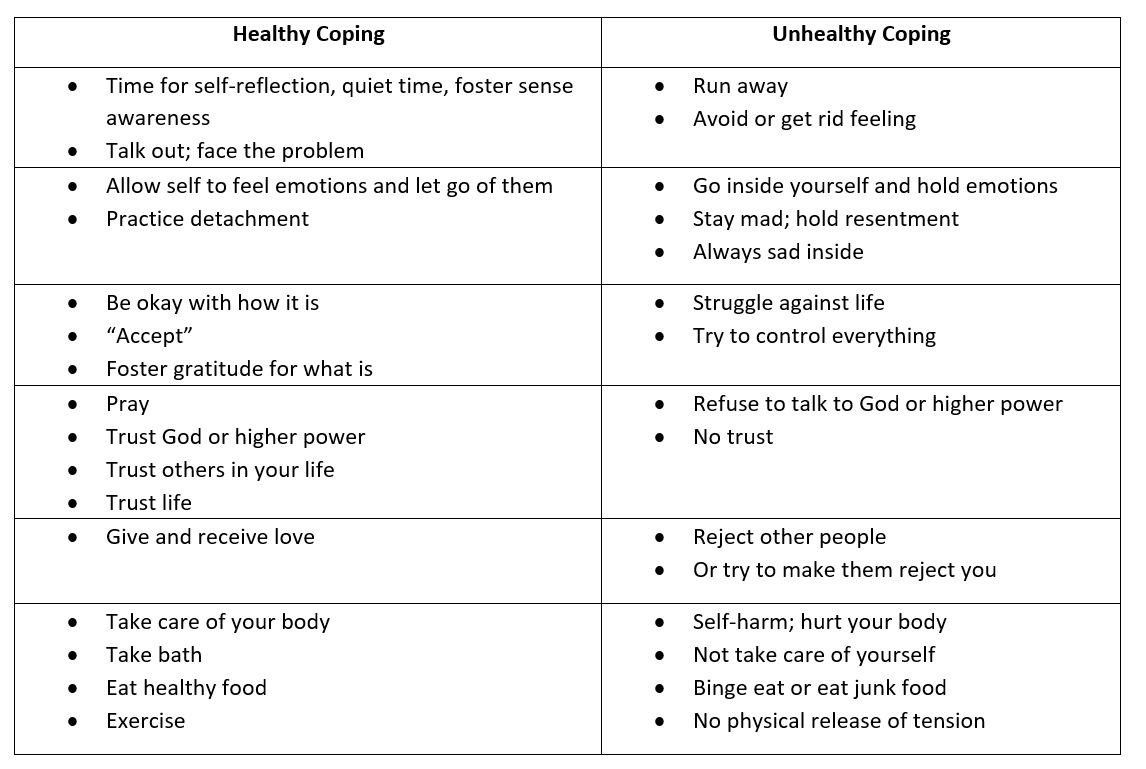
Chronic stress and adrenal gland imbalances will reduce a person’s ability to cope with stress. It is empowering for clients to hear that because of their hormone imbalances layered with trauma and stress, they may not be using the most well-adapted coping skills. So, we look at the description of what healthy and unhealthy coping skills are and we brainstorm together. The big questions are, “what is working for you?” and “what is not really working for you?”
We first identify what is my client’s “go-to” healthy coping mechanism. This might be a dominant belief or habit that she falls back on during a hard time in their life, or a way the cope now with a difficult situation. We recognize this strength but note while it is their “favored” coping skill, it is not quite working as well as they think it usually does. Hence, the client is feeling overwhelmed. Ultimately, we aim to engage new, healthy coping mechanisms.
To understand my client, and not just hand them a list of platitudes and a pat on the back, I really dig in. What I really want to learn is their “go-to” unhealthy coping mechanism? For example, when they get pushed to the edge, what is that unhealthy, or faulty thought that keeps them in the loop of despair, anxiety, or tension? Once we find that unhealthy coping skill, we look at what the opposite or healthy version of that skill is on the chart.
Once I know what the client struggles with the most, I explain that the associated healthy skill is perhaps their weak link and help them feel no pressure to build on that skill. Instead, I have them focus on developing on or two new healthy coping skills. In this mindful way, it is more likely they can succeed and adopt that which is not opposite of their favored unhealthy coping mechanism.
For example, say a client becomes resentful and focuses their thoughts on anger or sadness. I would recognize that the healthy opposite is to practice detachment. For this person, talking out their concerns may not lead them to greater understanding, but simply serve as a way to wallow in their resentments. It is difficult for this person to feel emotions, but then let go of the hold they have on their thoughts and behaviors. So, we do not start with this practice.
Case Study
Susan is a 34-year-old mother of three young children whose husband is an essential healthcare worker. Susan’s strongest coping skill is self-identified as her trust in a higher power and the process of life. So, in her treatment plan, this skill is embraced. She creates time each morning and evening for her prayer time and devotionals, which is her usual coping mechanism. She also commits to participate in a weekly online devotional with her community church. However, it is acknowledged that this coping skill is not enough at this time, and she needs to diversify how she copes.
We next identify her weakest link or unhealthy coping skill. She reports a tendency to binge eat chocolate donuts after the kids go to sleep. We recognize that she may not be best served to focus on her time in quarantine with expectations of losing weight and fixate on nutrition. She can embrace other self-care skills, like a warm bath or taking a walk in nature. As able, I would help herself focus on good nutrition, but not set it up as a high expectation during extremely stressful times.
Instead, we work to identify two new healthy coping skills that she believes she can thrive in those new practices. She chooses the first one to focus on increasing her time for reflection and talking out her concerns. In this way, she sets up weekly video check-ins with a friend or counselor to discuss two experiences that triggered her, and at least two experiences that brought some awareness, sense of grace, or feeling of peace each week. She commits to journaling every other day to help develop greater self-awareness.
Secondly, she chooses to cultivate her capacity to “accept what is.” She works to identify two healthy ways she is controlling her environment for safety and structure purposes and then identify at least two ways she may be controlling in response to fear and anxiety. She adds daily meditation practice to her devotional readings to allow her breath as a tool for this “acceptance” feeling. She creates a gratitude jar for herself, her husband, and her kids to bring awareness to the blessings they receive daily. Lastly, she also trains her mind for moments during that time apart when her husband is at work with a guided imagery tool. If she begins to worry about his safety or sense life feels out of control, she redirects her thoughts, and imagines a white ball of light around him while she says a prayer of protection. She then imagines that light engulfing the patient he is helping, then expanding it around the entire hospital building. She then imagines the entire community as well as her own home in this white healing light. Then, the healing light is extended in her mind’s eye to encircle the globe. In this imagery and prayer, she is practicing acceptance of what is.
Through this technique, we empower Susan to use the coping skills she “owns” usually during times of stress, but which may not be serving her as well as usual. Her stress coping skills expands to at least two that she doesn’t usually lean on, while giving permission to avoid the way of coping that she struggles with the most. In this way, those clients who are mindful of this process as a skill-building exercise can thrive and shine, even during crisis.
About the Author: CJ Weber

Also on Integrative Practitioner

Dental Danger: Signs of Sleep Breathing Disorders in children and Adults, Learn the Visual Clues
Non-Member Price: $30.00 Member Price: $18.00 – 40% Off for Members Only Add to Cart Presented by: Mark Breiner, DDS,...

Integrative and Comprehensive Approach to Inflammatory Bowel Disease
Non-Member Price: $30.00 Member Price: $18.00 – 40% Off for Members Only Add to Cart Presented by: Ronald Hoffman, MD,...

Measuring Biology vs. Symptomatology: The Fully Integrated Functional Wellness Program
Non-Member Price: $30.00 Member Price: $18.00 – 40% Off for Members Only Add to Cart Presented by: Dane Donohue, DC...

Change Your Genes, Change Your Life
Non-Member Price: $30.00 Member Price: $18.00 – 40% Off for Members Only Add to Cart Presented by: Kenneth Pelletier, PhD,...
Guided Imagery – Efficacious, Portable, Scalable, User-Friendly, Self-Administered
Non-Member Price: $30.00 Member Price: $18.00 – 40% Off for Members Only Add to Cart Presented by: Belleruth Naparstek, ACSW...