








‘Eccentric Exercise’ Could Deliver Better Results Than Strenuous Exercise
By Irene Yeh
Muscle soreness is usually thought to be a part of building muscle size, strength, and performance, but new research says otherwise. Instead, “eccentric exercise” may deliver better results compared to strenuous workouts that cause muscle damage and delayed onset muscle soreness (DOMS).
“You can gain strength without feeling as exhausted. So, you get more benefit for less effort,” said Ken Nosaka, professor at the School of Medical and Health Sciences and director of exercise and sports science at Edith Cowan University in Australia, in a press release. In a study published in the Journal of Sport and Health Science (DOI: 10.1016/j.jshs.2026.101126), Nosaka examined the benefits of eccentric exercise and urged for further research on how it can contribute to overall health.
What Exactly is Eccentric Exercise?
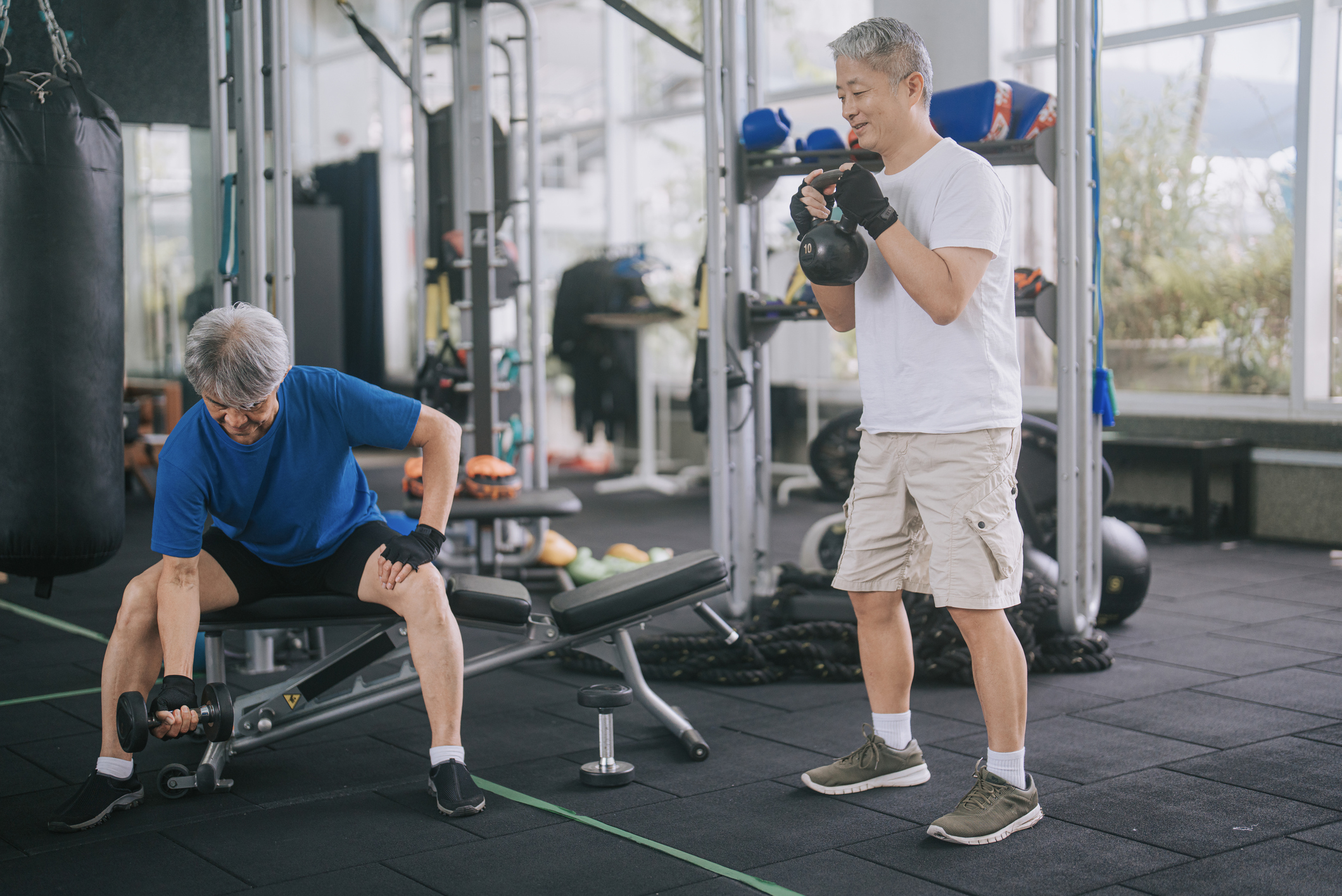
Muscle contractions are split into three categories: isometric, concentric, and eccentric. Eccentric muscle contractions occur when the muscles are lengthened, usually during the lowering phase of a movement, such as letting down a dumbbell and walking downstairs. In eccentric muscle contractions, the muscle produces less force than the load it is resisting and so lengthens under the tension. Conversely, during concentric contractions, the muscle generates more force than load, causing it to shorten. In isometric contractions, the muscle produces equal force to the load, so the length does not change.The difference between eccentric exercise and standard exercise is the focus on lengthening (eccentric) phase of a movement, giving that part of the movement longer duration. Unlike concentric and isometric exercises, eccentric exercise allows greater mechanical loading with lower perceived effort, which makes it ideal for strength development and rehabilitation. These moves also tend to cause less fatigue, enabling people to perform more repetitions at the same relative intensity and experience smaller drops in strength during repeated maximal efforts. Additionally, eccentric exercises can be used by a broad range of people, regardless of age, health conditions, and activity levels.
“These movements mirror what we already do in daily life,” said Nosaka. “That makes them practical, realistic, and easier to stick with.”
With that said, eccentric exercises require more focus and control, placing a higher cognitive load on the person performing them. However, the benefits of eccentric exercise are promising. Nosaka wrote that eccentric exercise should be standard practice and made common, accessible, and widely accepted as the “new normal” of exercise to improve life performance and high (athletic) performance.
Eccentric Exercises is for Everyone
For older adults, patients, and sedentary people, eccentric exercise is suitable for most of their physical activity needs because of its low-intensity and accessibility. Nosaka wrote that a study conducted by a team of researchers from National Taiwan Normal University, University of Taipei, and Edith Cowan University, where elderly obese women walked downstairs twice a week for 12 weeks (Medicine & Science in Sports & Exercise, DOI: 10.1249/MSS.0000000000001267). The participants were split into two groups: descending stair walking (DSW) and ascending stair walking (ASW). For the DSW group, they took an elevator to avoid going up the stairs while the ASW group descended the stairs.
The results of that study revealed improved cardiovascular function, insulin sensitivity, and cholesterol levels, as well as increased isometric contraction strength, in the DSW group. Nosaka emphasized how the study showed it was possible to introduce walking down the stairs without muscle damage by gradually increasing the exercise load. Future research is recommended to investigate the mechanisms of the effects of eccentric exercises in comparison to other exercise types.
For athletes, eccentric exercise training plays an important role in improving strength, power, speed, and change-of-direction performance while also reducing the risk of injury. It leads to specific adaptations in both the muscles and connective tissues that are especially useful for movements involving slowing down and absorbing force that are common in many sports. Furthermore, eccentric strength training produced similar improvements in concentric and isometric strength. This suggests that eccentric-focused training can broadly enhance neuromuscular function, which is critical for athletic performance. However, it is still unclear whether eccentric-only training by itself is enough to fully improve sport-specific performance, since athletes also need to train movements unique to their sport. More research is needed to better understand how eccentric training leads to these neuromuscular adaptations.
Nosaka also cited a study from the European Journal of Applied Physiology (DOI: 10.1007/s00421-025-05989-7), where a team of researchers from Edith Cowan University had participants partake in a five-minute home-based eccentric exercise routine over an eight-week period. The routine included chair squats, wall push-ups, chair-reclines, and heel drops—exercises that do not require special equipment. The results not only showed improved muscle strength, flexibility, and mental health, but it also demonstrated incentive in 90% of the participants to continue with regular exercise beyond the study. This highlights a smoother transition period from sedentary to active for people who are just getting into exercise and decreases the chances of lowered motivation. “When exercise feels achievable, people keep doing it,” Nosaka commented.
With its low intensity, easy accessibility, and improvements in muscle strengthening and performance, eccentric exercise is a suitable form of physical activity that has great benefits and promising long-term effects. Nosaka called eccentric exercise “an ideal intervention” for everyone.
About the Author: Irene Yeh

Also on Integrative Practitioner

Boston Children’s Hospital, Texas Children’s Hospital, Baylor College Receive Award for International Autism Research Project
By Integrative Practitioner Staff Last week, Boston Children’s Hospital, Texas Children’s Hospital, and Baylor College received grants for up to $17.5 million each from...

Biological Age Blood Test Predicts Diseases Before Onset
By Allison Proffitt Researchers at Stanford University have developed a blood test that reveals the functional age of your organs,...

University Hospitals Receive PCORI Grant for Complex Psychiatric Disorders Treatment and Access
By Integrative Practitioner Staff University Hospitals in Cleveland has secured $1 million in funding from the Patient-Centered Outcomes Research Institute (PCORI). PCORI is a...

Higher-Intensity Exercise Linked to Lower Depression and Anxiety Symptoms
By Irene Yeh Physical activity usually correlates with improved depression and anxiety symptoms. However, it isn’t just the frequency of exercise but the intensity...

Creative Arts Support Improvements in Trauma Recovery
By Irene Yeh Creative arts and activities are associated with improvements in psychological and physical health, as well as social...