





Traditional Chinese Medicine to manage pain
By Melissa Carr, BSc, DrTCM
As healthcare providers, the increasing problems of chronic pain, opioid use, and drug addiction can be challenging when it comes to finding treatment options.
In 2016, there were roughly 42,000 opioid-related deaths, five times higher than In 1999, according to the Centers for Disease Control and Prevention (CDC). In 2014, close to two million Americans (26 to 36 million people worldwide) were found to be either abusing or dependent on prescription opioid pain medication.
Many of the approaches we in Traditional Chinese Medicine (TCM) take in evaluating pain are not much different from those of other health professions. We can look at blood tests or imaging results, but if those aren’t provided, we can’t request them, so we often have only our senses—what we see, hear, feel, and smell—to take in information for diagnosis.
When I greet a patient in the waiting room, I watch how they stand up from their chair, how they move, and how they walk (or wheel) into the treatment room. I feel the strength of their grip and the temperature of their hand if they shake hands with me. I pay attention to their complexion and their overall demeanor:
- How strong or quiet, raspy, or clear is their voice?
- Do they stay standing when they come into the treatment room because sitting hurts?
- If they are seated, do they reposition their chair so they don’t have to turn their head to look at me while I chart?
- How is their posture?
- Do they shift their position frequently?
- Are they perspiring?
I also ask questions about their pain:
- Where does it hurt?
- Does it radiate or move around?
- How long have they had it?
- What makes it worse or better?
- What have they done and are they doing now to address it?
- What is the intensity and quality of the pain?
This information helps to categorize the pain into a TCM diagnostic pattern, which may sound unfamiliar to non-TCM practitioners.
Pain is always classified as stagnation—something is not moving well. There is a common quote in TCM that is translated as:
“Where there is pain, there is no free flow. Where there is free flow, there is no pain.”
When pain is chronic, such as arthritis, we may classify it as a “Bi” syndrome, which translates as “obstruction” syndrome.
Then we have to get more specific about the type of stagnation. For example, dull, aching pain that is worse upon arising, but improves with movement, is what we term “Qi stagnation.” Pain, like gout, that is red, swollen, and warm to the touch includes a TCM diagnostic of “Heat.” Pain that moves around—one day in the neck, another day in a knee, and another in the fingers, for instance—is categorized as “Wind.” Sharp stabbing pain that keeps the patient up at night qualifies as “Blood stagnation,” though doesn’t necessarily mean a blood clot. Severe pain with stiffness and swelling in the joints, and is worse in winter, is “Cold-Dampness” pain.
It’s also quite likely that a patient will have a lot of these things going on simultaneously, leaving us with a diagnosis like “Qi and Blood stagnation with Wind-Cold-Damp Bi syndrome.”
Some patients can’t offer much information, so varied or hard to define is their pain. Luckily, TCM also has us ask about the patient’s other health conditions, past medical history, family medical history, sleep, digestion, nutrition, habits and lifestyle, emotions, and a basic head-to-toe overview. In this, we may discover that the patient hasn’t been eating because the pain makes it hard to cook or because of nausea. We may find out that anxiety for provoking more pain has left the patient avoiding exercise or movement. We may discover that the patient’s work requires them to do movements, or all day sitting, that makes the condition worse.
Two diagnostic tools that TCM uses differently from other health professions are pulse and tongue diagnosis. We feel for the speed, strength, and quality of the pulse at three locations and three depths on each wrist. We look at the color, shape, and size of the body of the tongue and the thickness, quality, and color of the coating of the tongue.
Once a patient is on the table, we may do range of movement and strength tests. We’ll palpate the areas of pain and other possibly associated structures. We feel for tightness, laxity, knots, bumps, weakness, depressions, warmth, or cold, and we ask the patient for feedback about their sensations. Sometimes the patient is surprised about pain caused by finger pressure on a point away from their usual pain area. Many practitioners know these as trigger points. They are often at acupuncture points that we can use to help in the diagnosis.
Clinical Take-Home
TCM’s assessment of pain as blockage can be applied by virtually anyone. The body is designed to heal, but if blood flow is impeded by muscle tension, swelling, or scar tissue, consider what can be done to restore proper circulation:
- Is there a problem upstream or downstream from the area of pain?
- Is someone’s posture or habit impairing healing, though it may be temporarily relieving pain?
- Based on the assessment, what homework can be given to the patient to help counter the pain and speed recovery?
If a thorough assessment has not been done, make sure that someone completes one, especially when the pain condition is chronic or complicated.
Acupuncture
When people think of TCM, they usually think of acupuncture. In fact, conversely, many don’t even think of TCM when they think of acupuncture because many non-TCM practitioners use it as part of their treatments.
Most of the research on acupuncture has been an assessment of its effect on the management of pain, from knee arthritis and low back pain to migraines and fibromyalgia. Media and regulatory associations have touted the benefits of acupuncture to address pain, even changing treatment guidelines, as the American College of Physicians did in recommending acupuncture as a first line treatment for low back pain.
When it comes to treating pain, acupuncture is usually my first recommendation. In selecting acupuncture points, TCM practitioners will consider acupoints both local and distal to the area of pain, based on the TCM diagnosis. Sometimes we don’t put any needles directly at the pain location, especially when the pain is severe and the patient is sensitive. Other times, we specifically select those pain points, even if they are not exactly at charted acupuncture point locations. In that case, those points are called “ashi,” which is translated as “Ah, yes!” as in, that’s exactly where the pain is.
For many, pain is at least somewhat diminished directly after treatment, particularly if the pain is acute or caused by muscle tension. For others, I inform them that they may need three to eight sessions, depending on each case, to shift their pain. Some still feel sore when they leave the treatment, but notice improvement each day after. Others feel better for a few hours, but then feel sore again. In that event, the goal is to lengthen the amount of time of pain relief following each session, so they feel better for longer periods until they have no pain, or their pain is manageable.
Furthermore, if an opioid addiction is already at play, acupuncture may help, and there are addiction protocols, such as standards set by the National Acupuncture Detoxification Association (NADA).
TCM practitioners may also employ tui na massage, cupping, gua sha scraping, moxibustion, electrostimulation, biopuncture, or other modalities to treat pain.
Clinical Take-Home
For practitioners doing acupuncture or other hands-on therapies, we can use our treatment time to look for or feel for anomalies. The Mayo Clinic documented case reports of incidents where acupuncturists and massage therapists provided vital health information that may otherwise have been missed.
Practitioners who see patients on a more regular basis may also note changes in patient demeanor or symptoms that are red flags for further medical attention. If the patient is not receiving hands-on treatment, referrals can be made to acupuncture, massage, chiropractor, osteopath, physiotherapist, kinesiologist, or others.
Herbs
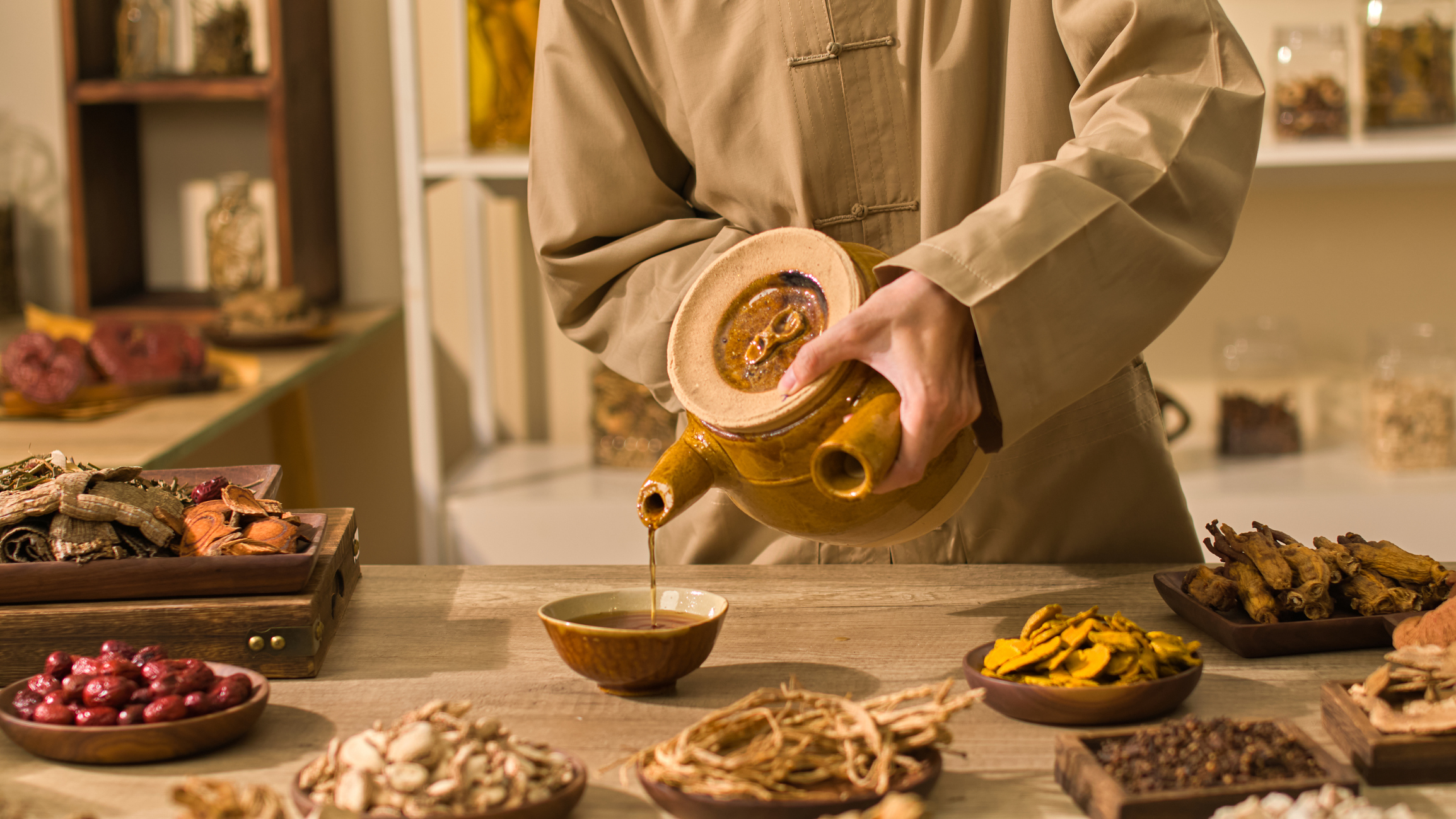
For chronic pain conditions, a TCM herbal formula may be prescribed. While we recognize that certain herbs do have a known biochemical action to decrease inflammation, buffer pain, or improve blood flow, there is no standard pain relief formula. If a person has Wind-Cold-Damp Bi syndrome as their diagnosis, we will prescribe different herbs than if they have Damp-Heat Bi Syndrome or Blood stagnation.
Some herbs used in pain formulas, not suitable for every case, but frequently considered, based on the TCM diagnosis, include:
- Jiang huang (Curcuma longa)
- Yu jin (Curcuma aromatica)
- Yan hu suo (Corydalis yanhusuo,
- Chuan lian zi (Melia toosendan)
- Di long (earthworm)
- Huo xiang (Agastaches rugosus)
- Du huo (Angelicae pubescentis)
- Bai shao (Albus paeoniae lactiflorae)
This list is not all-inclusive. If a TCM practitioner deems that the patient’s diagnosis is pain from body weakness, herbs like ginseng and astragalus may be prescribed, and though those herbs are not usually considered for managing pain by Western herbalists, for the right condition, they can be an important part of a pain formula.
Clinical Take-Home
It’s worth considering if a patient may benefit from a customized herbal formula for managing their pain and supporting their healing. While it’s essential to be cautious of potential drug-herb interactions and make sure that a qualified practitioner prescribes herbs for the whole person, not just the symptom of pain, there are many herb options to draw from that have pain-relieving benefits.
Because patients with chronic pain often have many byproducts of their suffering, including addiction, depression, anxiety, insomnia, grief, digestive disorders, and more, a thorough whole person approach, often as a team of integrative practitioners, is particularly valuable.
About the Author: CJ Weber

Also on Integrative Practitioner

Dental Danger: Signs of Sleep Breathing Disorders in children and Adults, Learn the Visual Clues
Non-Member Price: $30.00 Member Price: $18.00 – 40% Off for Members Only Add to Cart Presented by: Mark Breiner, DDS,...

Integrative and Comprehensive Approach to Inflammatory Bowel Disease
Non-Member Price: $30.00 Member Price: $18.00 – 40% Off for Members Only Add to Cart Presented by: Ronald Hoffman, MD,...
Measuring Biology vs. Symptomatology: The Fully Integrated Functional Wellness Program
Non-Member Price: $30.00 Member Price: $18.00 – 40% Off for Members Only Add to Cart Presented by: Dane Donohue, DC...

Change Your Genes, Change Your Life
Non-Member Price: $30.00 Member Price: $18.00 – 40% Off for Members Only Add to Cart Presented by: Kenneth Pelletier, PhD,...
Guided Imagery – Efficacious, Portable, Scalable, User-Friendly, Self-Administered
Non-Member Price: $30.00 Member Price: $18.00 – 40% Off for Members Only Add to Cart Presented by: Belleruth Naparstek, ACSW...