






Treating “frozen shoulder” Traditional Chinese Medicine
Photo Cred: Karolina Grabowska/Pexels
By Melissa Carr, BSc, DrTCM
Also known as adhesive capsulitis, frozen shoulder is so named because there can be greatly limited movement in the joint, in addition to pain in the shoulder. While it can resolve on its own, typically in one to three years, the pain and dysfunction can be severe and intrusive, so patients want and need a faster resolution. The causes of this condition are not well understood, but there are some factors associated with a greater risk, and that information, along with a proper Traditional Chinese Medicine (TCM) diagnosis, can help guide treatment.
Acupuncture is an excellent option for treating frozen shoulder, but it is not the only TCM modality. Other manual therapies include cupping, moxibustion, tui na massage, gua sha, and injection therapies. Chinese herbal formulas, nutritional recommendations, lifestyle changes, and exercises are further TCM treatment options. Proper TCM diagnosis is the first step.
Qi and Blood Stagnation
Wherever there is pain, there is stagnation of Qi. Frozen shoulder is more likely to occur after immobilization due to injury or surgery, both of which can precipitate Qi and Blood stagnation. Qi stagnation generally causes dull, aching pain, while Blood stagnation is more likely to result in stabbing, localized pain that might be worse at night. In TCM, environmental elements like Wind, Cold, and Damp can also result in stagnation and the diagnosis of Bi zheng, or “obstruction syndrome.” Bi syndrome is commonly, but not always, associated with the western diagnosis of arthritis.
The channels that run through the shoulder area are the Large Intestine, San Jiao (Triple Warmer), Small Intestine, Gallbladder, and Lung, so acupuncturing the affected meridians is one way to move Qi, improve circulation, and speed healing. Wind in the channel can cause moving pain, tremor, or numbness; Cold causes strong pain and limited motion; and Damp causes swelling, stiffness, and feeling of heaviness. The three factors are commonly combined with one or two being dominant.
In addition to local shoulder acupuncture points like LI14, SJ14, SI9, GB21, and LU3, Xi Cleft points are used to treat pain in the channel, so selecting the Xi Cleft point of the affected channel can also help. GB20 can release Wind while SP9 or ST40 can help reduce Dampness. Moxibustion around the shoulder can warm Cold stagnation. To move Qi and relieve pain, LI4 is commonly selected, while SP10 moves Blood. ST38 is an excellent point to treat shoulder pain and GB34 addresses the tendons and ligaments.
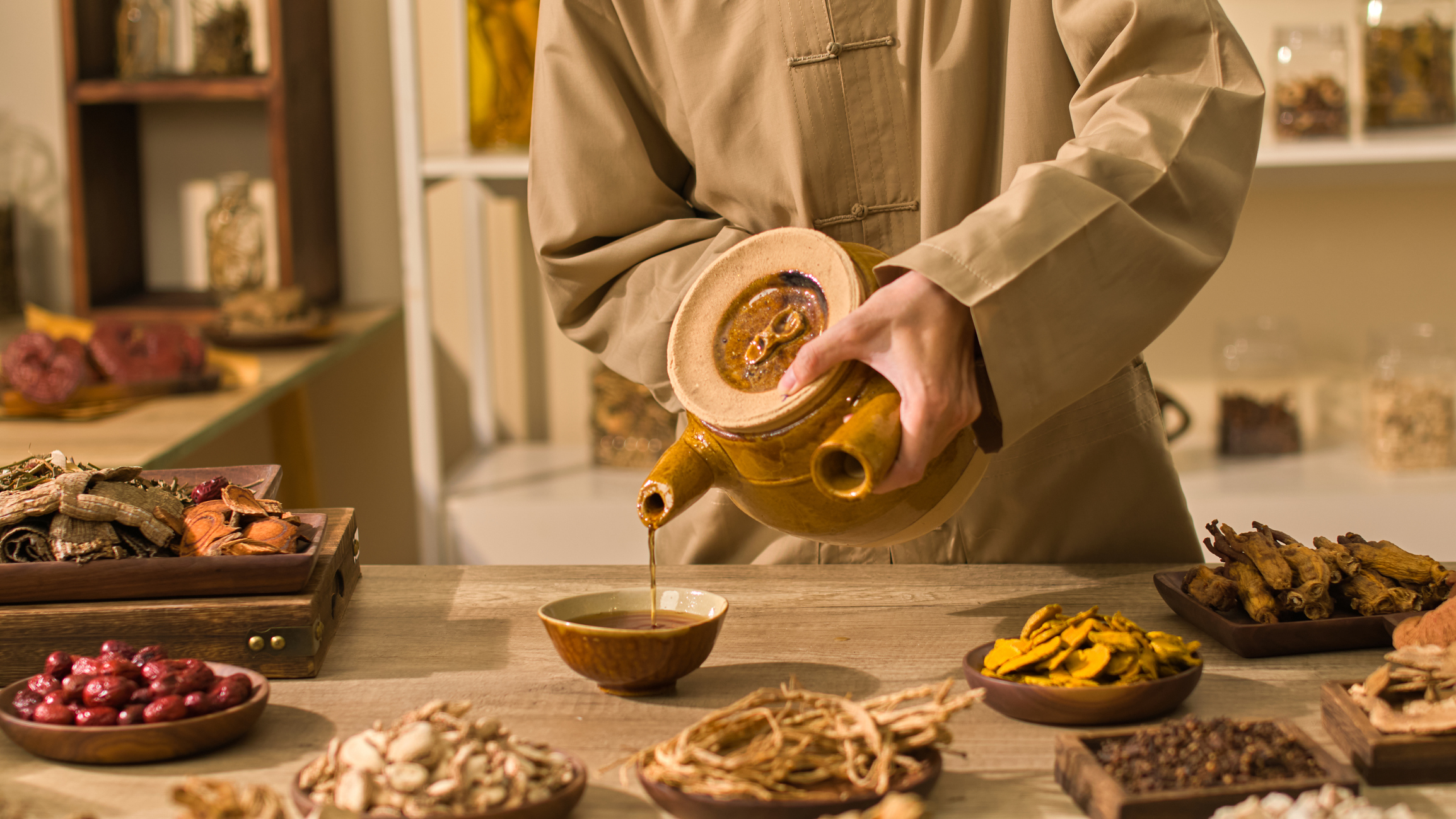
Juan Bi Tang is a common formula to treat Wind-Cold-Damp Bi syndrome with Qi and Blood stagnation in the upper body, including shoulder pain. It should be modified to address whether the condition has more Wind (consider increasing fang feng), Cold (consider adding gui zhi, xi xin, and possibly fu zi), or Damp (consider adding cang zhu, fu ling, or yi yi ren). To address pain and move Qi and Blood, yan hu suo, mo yao, ru xiang, or chuan lian zi are possible herbs to include.
Cupping, gua sha (scraping technique), and tui na massage are excellent treatment modalities to include or as an alternative to acupuncture, as all help move Qi and Blood. Qi gong, tai chi, or other exercises can help to gently mobilize the joint, while instruction to keep the joint warm can help reduce aggravation and further stiffening of the tissues.
Kidney and Liver Deficiency
The Kidneys regulate the bones while the Liver controls the ligaments, tendons, and connective tissues. Frozen shoulder is more common in those with diabetes, thyroid disease, Parkinson’s disease, or heart disease. It is also more likely to happen for women, 60 to 70 percent more likely, who are aged 40 to 60 years, around the time of perimenopause and the start of menopause. It’s not surprising to TCM practitioners, then, that Kidney and Liver deficiencies are common with these risk factors and diseases.
Kidney deficiency signs include thinning bones, low back pain, knee pain, leg weakness, premature hair graying, hair loss, dental problems, infertility or menopause, tinnitus, hearing loss, congenital disorders, phobias, and fear. Liver deficiency signs include blurred vision, dry eyes, floaters, scanty menstruation or amenorrhea, dizziness, weak tendons or ligaments, muscle cramping, peeling or brittle nails, depression, and irritability. Both deficiencies result in fatigue.
Though the Kidney and Liver channels do not pass through the shoulders, points along these channels can help recover the organ deficiencies. KI3 is a common Kidney Qi, Yin, and Yang tonifying point, while LIV8 nourishes Liver Yin and Blood. Though acupuncture can help address the pain and immobility of the shoulder and the points previously mentioned to move Qi and Blood are good options, herbs are typically better at nourishing deficiencies, so both can be done concurrently.
A common pattern of Liver and Kidney Yin deficiency can be addressed with the formula Yi Guan Jian, which also contains the Blood mover dang gui and the Qi mover chuan lian zi, though more can be added. Including bai shao yao can help soften the Liver, relieve pain, and nourish Liver Blood.
Case Study
Janice is a 52-year-old woman with frozen shoulder. She came in thinking a few acupuncture needles in the right place would resolve the issue she had been struggling with for over two years. She had tried several other therapies, including physiotherapy, intramuscular stimulation (IMS), osteopathy, and massage, but with limited improvement. I suggested that her problem was not resolving solely with manual treatment, as it may be more of an internal, hormonal imbalance issue.
The shoulder problem began around the time she started to get night sweats, irritability, insomnia, and vaginal dryness. She had long had low iron, a tendency toward missing periods, fatigue, low back pain, and tinnitus. I diagnosed her with Kidney Yin and Liver Blood deficiency along with Qi and Blood stagnation.
I acupunctured local shoulder points as well as KI3, KI6, LIV3, LIV8, SP10, REN4, and LI4 and gave her a modified formula of Zhi Bai Di Huang Wan. I added bai shao yao, dan shen, dang gui, yan hu suo, and yu jin. I included the herb man jing zi (chastetree berry) because though in TCM this herb is in the materia medica category to “release the exterior,” and used to clear Wind-Heat with symptoms like headache and eye pain, it is commonly used in Western herbal medicine to stimulate progesterone and normalize estrogen.
Though it took almost three months and 12 acupuncture sessions, she was finally able to regain full range of motion with her shoulder.
About the Author: CJ Weber

Also on Integrative Practitioner

Dental Danger: Signs of Sleep Breathing Disorders in children and Adults, Learn the Visual Clues
Non-Member Price: $30.00 Member Price: $18.00 – 40% Off for Members Only Add to Cart Presented by: Mark Breiner, DDS,...

Integrative and Comprehensive Approach to Inflammatory Bowel Disease
Non-Member Price: $30.00 Member Price: $18.00 – 40% Off for Members Only Add to Cart Presented by: Ronald Hoffman, MD,...

Measuring Biology vs. Symptomatology: The Fully Integrated Functional Wellness Program
Non-Member Price: $30.00 Member Price: $18.00 – 40% Off for Members Only Add to Cart Presented by: Dane Donohue, DC...

Change Your Genes, Change Your Life
Non-Member Price: $30.00 Member Price: $18.00 – 40% Off for Members Only Add to Cart Presented by: Kenneth Pelletier, PhD,...

Guided Imagery – Efficacious, Portable, Scalable, User-Friendly, Self-Administered
Non-Member Price: $30.00 Member Price: $18.00 – 40% Off for Members Only Add to Cart Presented by: Belleruth Naparstek, ACSW...