







An overview of “inflammaging”
By Nancy Gahles
There exists a fascination with the “magic” of the immune system. We ponder the dips in our health as effects of a lowered immune system, but we are often perplexed about how this happens. When we get a cold, we opine its etiology as a lowered immunity. In actuality, mounting a proper defense against a virus and producing symptoms of this defense in showing the symptoms of nasal discharge, fever, sneezing, and mucous production is the sign of a healthy, functioning immune system. Why, then, should we suppose that our immune system is going awry as we age, producing a continuous low-grade inflammation creating disease states?
The immune system of older people does not actually go awry, it becomes responsive to the overload of a lifetime of a considerable amount of environmental influences as well as complex genetic and antigenic stimuli that expose varying degrees of vulnerability.
Inflammaging refers to a continuous, low-grade inflammation associated with aging. According to one study, Inflammation & allergy drug targets, “chronic inflammatory responses could build up with time and gradually causes tissue damage. It is considered as one of the driving forces for many age-related diseases such as diabetes, atherosclerosis, age-related macular degeneration (AMD), and skin aging.”
The evidence is slowly building a case that indicates aging is driven by the pro-inflammatory cytokines and substances produced by our body’s innate immune system. Our own innate immunity has recently garnered more attention as it appears to be involved in the pathogenesis of several well-known inflammaging-associated diseases, such as AMD and atherosclerosis.
Inflammaging becomes a pathological phenomenon and a central concept that brings together our understanding of age-related chronic disease, functional decline and frailty across the lifecourse, according to Daniel Baylis in his article, Understanding how we age: insights into inflammaging.
The central concept of inflammaging is characterized by the upregulation of the inflammatory response that occurs with advancing age. Simply put, inflammaging is “believed to be a consequence of a remodelling of the innate and acquired immune system, resulting in chronic inflammatory cytokine production, according to Baylis.
In Chinese medicine, the analogy would be that if there is fire, we need the water element to put it out. Enter the anti-inflammaging response, an upregulation of the hypothalamic-pituitary axis, leading to higher levels of cortisol and subsequent vulnerability, frailty, and less successful aging.
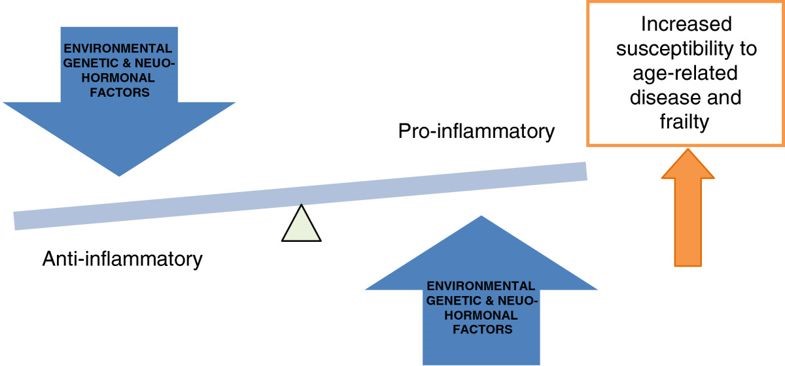
Image source: DOI 10.1186/2046-2395-2-8
This constant seesawing, a vicious cycle, drives the remodeling of the immune system and favors a chronic proinflammatory state where tissue injury and repair occur simultaneously and incur a debt of cellular damage that accumulates over time unnoticed.
I was feeling exhausted in my own aging body when reading about this continual process of inflammaging and anti-inflammaging when I came upon this description by Graham Pawelec, PhD, a researcher at the University of Tuebingen in Germany, in his study, Hallmarks of human “immunosenescence”: adaptation or dysregulation?
“Immunosenescence of the acquired system has received a great deal of attention in recent years and is by a cellular ‘exhaustion’, which can contribute to inflammaging,” he said.
According to Samuel Melamed, PhD, and co-authors of the 2006 paper, Burnout and risk of cardiovascular disease: evidence, possible causal paths, and promising research directions, immunosenescence is the term applied to the overall change to the immune system that happens with ageing. It has the exact feel of burnout syndrome as presents in the end stage pathophysiology of cardiomyopathy, musculoskeletal disorders like arthritis and fibromyalgia and the metabolic syndrome, dysregulation of the HPA axis, systemic inflammation, and impaired immunity functions.
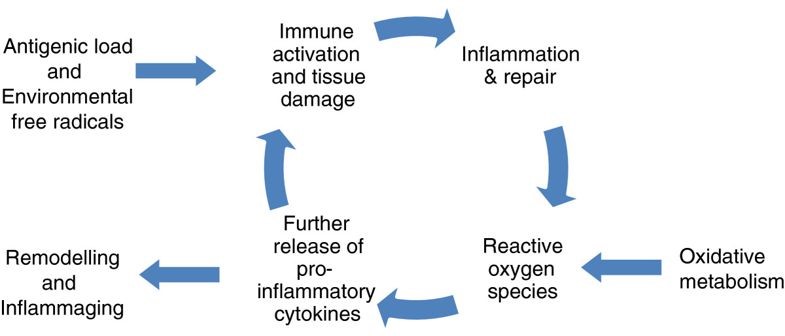 Image source: DOI 10.1186/2046-2395-2-8
The cellular exhaustion of immunosenscence in the aging phenomenon, and the vital exhaustion that manifests as burnout syndrome in all ages of life, are strikingly similar. Both have the proinflammatory cytokine etiology and both are implicated in a host of similar conditions associated with inflammation, poor physical performance, decreased muscle strength or frailty syndrome, osteoporosis, dementia, heart failure, inflammatory bowel disease, rheumatoid arthritis, systemic lupus erythematosus sarcopenia, and beyond.
It stands to reason then that some of the same strategies for reducing vital fatigue, increasing immune vitality, reducing the pro-inflammatory environment, and regulating the HPA axis will serve to diminish the inflammaging cellular damage and result in less ravaging chronic disease and graceful aging.
My top pick for global self-regulation is homeopathic medicine for its whole person, totality of symptoms, and individualized approach to healing.
The 2016 Homeopathic medical practice for anxiety and depression in primary care: the EPI3 cohort study is the largest comparative effectiveness study. This was one of three epidemiological cohort studies (EPI3) on general practice in France and compared use of conventional psychotropic drugs among patients seeking care for anxiety and depression disorders from general practitioners who strictly prescribe conventional medicines, regularly prescribe homeopathy in a mixed practice, or are certified homeopathic practitioners. The study found patients treated by homeopathic practitioners or in mixed practices were less likely to use psychotropic drugs over 12 months, and the rate of clinical improvement was marginally higher for patients seen by a homeopathic provider compared to the conventional medicine group.
Another study in the EP13 series showed that patients who consult family physicians certified in homeopathy used significantly less antibiotics and anti-pyretic or anti-inflammatory drugs for upper respiratory infections than those who attended family physicians who prescribe only conventional medicine.
The implications from these studies show that there can be a reduction in the inflammaging with homeopathic medicine.
My second pick is mindfulness meditation. Symptoms of emotional distress or psychopathology can be accompanied by inflammatory processes. Worrying, a hallmark for most of us but a predominant state in the aging population, is linked with inflammation. One of my favorite studies published in 2013 in the Journal of Inspired Living demonstrates that rumination causes inflammation. Rumination is the process of going over and over a thought in your head until it becomes chronic.
Frontiers in Aging Neuroscience also published an article, Mindfulness Training for Healthy Aging, linking mindfulness to a myriad of health sequelae.
“There are several mechanisms through which mindfulness training may alter inflammatory processes: alteration of the hypothalamic-pituitary-adrenal axis or sympathetic nervous system functioning,” the article posits.
These two systems are implicated in the transduction of the brain’s perception of socio-environmental conditions into genomic responses through their production of stress-related hormones such as cortisol, epinephrine, and norepinephrine that directly alter expression of pro-inflammatory genes.
Similarly, in a study of community dwelling older adults, baseline levels of loneliness were associated with expression of the pro-inflammatory gene NF-kB. Those who participated in an eight-week Mindfulness Based Stress Reduction (MBSR) course exhibited significant down regulation of NF-kB expression compared to a waitlist. The evidence is mounting that mindfulness may be beneficial for promoting cognitive, emotional, and physical health within the context of advanced aging.
The ravages of inflammation that “necessarily” come with aging and that appear to be a complex etiology such that we throw our hands up in acceptance now appear to have strategies to deflect the cycle of continuous, low-grade inflammation associated with the chronic degenerative diseases of aging. Indeed, we now have a window of opportunity to employ some of the most skillful strategies that are low cost, safe, and effective.
About the Author: CJ Weber

Also on Integrative Practitioner

Dental Danger: Signs of Sleep Breathing Disorders in children and Adults, Learn the Visual Clues
Non-Member Price: $30.00 Member Price: $18.00 – 40% Off for Members Only Add to Cart Presented by: Mark Breiner, DDS,...

Integrative and Comprehensive Approach to Inflammatory Bowel Disease
Non-Member Price: $30.00 Member Price: $18.00 – 40% Off for Members Only Add to Cart Presented by: Ronald Hoffman, MD,...

Measuring Biology vs. Symptomatology: The Fully Integrated Functional Wellness Program
Non-Member Price: $30.00 Member Price: $18.00 – 40% Off for Members Only Add to Cart Presented by: Dane Donohue, DC...

Change Your Genes, Change Your Life
Non-Member Price: $30.00 Member Price: $18.00 – 40% Off for Members Only Add to Cart Presented by: Kenneth Pelletier, PhD,...
Guided Imagery – Efficacious, Portable, Scalable, User-Friendly, Self-Administered
Non-Member Price: $30.00 Member Price: $18.00 – 40% Off for Members Only Add to Cart Presented by: Belleruth Naparstek, ACSW...