





Traditional Chinese Medicine treatments for temporomandibular joint pain
Photo Cred: PCH.Vector/Freepik
By Melissa Carr, BSc, DrTCM
The temporomandibular joint (TMJ) is the point of connection between the mandibular fossa of the temporal bone and the condyle of the mandible. Like many joint issues, temporomandibular joint dysfunction (TMD) pain can involve multiple tissues, and despite detailed imaging, diagnostics and cause often remain at least partially unknown.
Common causes of TMD include bruxism (teeth grinding or clenching), arthritis, poor posture, and injury to the head or neck. Additionally, over the past year and a bit, we’ve seen a new aggravator of TMJ dysfunction and pain, mask wearing. While wearing masks remains one of our best tools for slowing the spread of the novel coronavirus (COVID-19), as healthcare providers, we can advise how to reduce the negative impacts, including breathing through the nose, not the mouth, keeping the lips closed, lightly touching the tip of the tongue to the upper palate, and relaxing the jaw.
Traditional Chinese Medicine and TMD
Acupuncture is now widely recognized for its effectiveness in managing pain conditions, so it is the most likely Traditional Chinese Medicine (TCM) treatment to be recommended for TMJ pain and dysfunction. The meridians or channels that traverse or pass close to the TMJ include Gallbladder (GB), Small Intestines (SI), San Jiao (SJ) or Triple Warmer (TW), and Stomach (ST).
Local points often chosen for TMD include GB2, GB3, SJ21, SI19, or ST7. If there is neck and occipital pain, GB20, GB21, and UB10, as well as some of the huo tou jia ji points of the cervical vertebrae may be included. TMD with jaw clenching or teeth grinding might include acupuncture of the temporalis muscles with GB4-9 (I usually choose GB8) and Taiyang, and masseter muscles with ST6. Involvement of the sternocleidomastoid muscles are common in TMD, so use diagnosis and palpation to select amongst GB12, SJ16, SJ17, SI16, ST9, ST10, LI17, and LI18.
One of the most recognized acupuncture points is LI4, also called Hegu. This point, at the back of the hand, between the thumb and index finger, is used for the treatment pain and dysfunction of the head and face. It’s an easy point to acupressure, so you can teach your patients to press on it to help relieve their symptoms of TMD, even if you don’t practice acupuncture.
Like with any other illness, disease, or dysfunction, the TCM treatment approach requires a TCM diagnosis. In other words, there is no one diagnosis or treatment for TMD, and it’s important to assess the whole person, not just their symptom of jaw pain. However, Liver or Gallbladder Qi stagnation is commonly included in the TCM diagnosis of TMD.
The Liver and Gallbladder are paired organs in TCM—as they are anatomically and physiologically—but in TCM, these organs are also involved in a diverse range of physical and mental processes and symptoms. The TCM Liver assists the free flow of Qi and Blood through the body, stores the Blood, helps regulate cycles, nourishes the eyes and the tendons and ligaments, and is involved with the emotions of anger, frustration, and irritability.
The TCM Gallbladder holds much more value than just a sac that holds bile. In addition to its involvement with digestion through its release of bile, the Gallbladder is said to be responsible for supporting our tendons and ligaments and assisting our ability for judgement, making decisions, and providing initiative and courage.
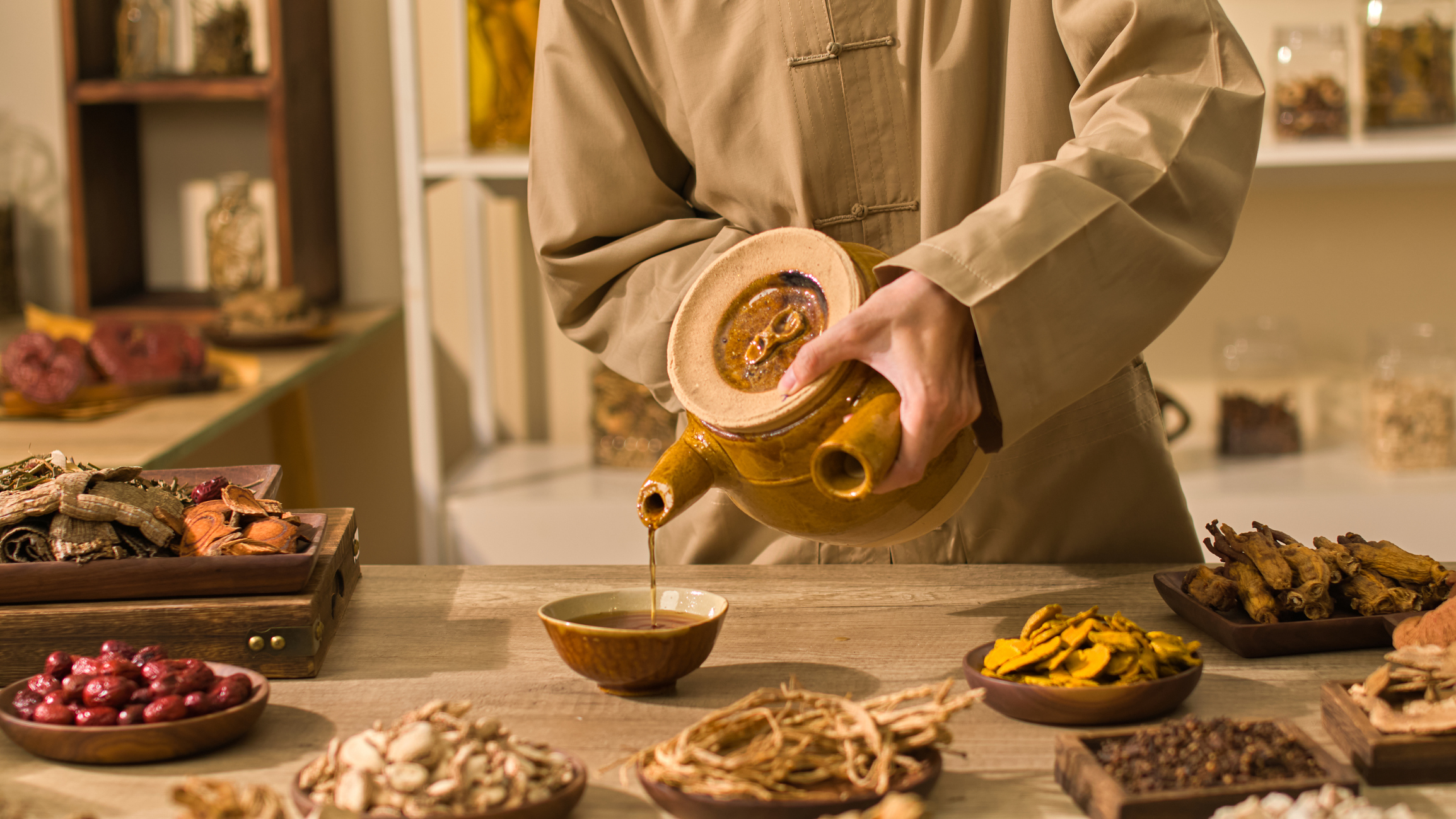
When TMJ pain is accompanied by Liver and Gallbladder patterns of dysfunction, modified versions of the formulas Xiao Yao San, Shu Gan San, Chai Hu Shu Gan San, Wen Dan Tang, or Long Dan Xie Gan Tang may be considered. For acupuncture, in addition to local acupoints, GB34 supports the tendons and ligaments, LIV3 moves stuck Liver Qi, and LI4 helps relieve pain, particularly on the head and face.
If there are Spleen Qi deficiency symptoms like bloating, diarrhea, overthinking, fatigue, foggy-headedness, and organ prolapse, then SP6, SP4, and SP3 are helpful, as is the inclusion of herbs like ren shen or dang shen, bai zhu, huang qi, and fu ling. If there is Liver Blood deficiency causing blurred vision, dizziness, and paleness, then LIV8 is a good add, as are the herbs dang gui, bai shao, and gou qi zi. Yintang and DU20 (GV20) can help calm the mind, along with calming herbs like ling zhi, yuan zhi, he huan hua, and bai zi ren.
TMD is more common in women than men, and hormonal fluctuations, particularly with regard to estrogen, appear to play a significant role. One of the TCM organ systems frequently associated with PMS symptoms and menstrual irregularities is the Liver.
Case Study
A 47-year-old woman complained of jaw pain. She had a long history of teeth clenching and TMD, and she was unable to open her mouth fully without it clicking or feeling like it would get stuck. Her jaw often felt tight, especially during times of stress, and particularly after wearing a mask all day at work.
She also had frequent neck pain and tension with occasional temporal or frontal headaches. She had a regular menstrual cycle, but often felt fatigued during and after her period and was taking iron supplements at the advice of her medical doctor. Her bowel movements tended to be frequent and soft, but she had a healthy diet and a good appetite. She had started doing yoga at home and taking magnesium supplements before bed to help with managing stress and relaxing her muscles, but she still often felt overwhelmed by work.
I diagnosed her with Liver Qi stagnation, Liver attacking Spleen causing Spleen Qi deficiency, and Blood deficiency and started her on the formula Xiao Yao San plus yan hu suo, chuan lian zi, and yu jin (turmeric) to address her pain, ling zhi (reishi) to help as an adaptogenic and calm her nervous system, and extra bai shao to “soothe the Liver,” nourish the Blood, and relax muscles and tendons. Though used in TCM to “release the Exterior” and treat Superficial Wind-Heat, which is most equivalent to a cold or flu, I also included man jing zi (vitex/chasteberry) to help address her PMS symptoms.
I provided twice weekly appointments for two weeks and then reduced to weekly for another three months. I alternated treatment with her prone or supine, choosing amongst the acupuncture points ST36, SP6, SP9, LIV3, LIV8, Zi Gong, REN4 (CV4), LI4, Yintang, Taiyang, ST7, and GB8 or SJ17, GB20, GB21, hua tou jia ji at cervical vertebrae, trigger points in infraspinatus muscles, UB15, UB18, UB20, and UB23. Each session consisted of 8 to 20 points.
I instructed her to ensure that when she wore her mask, to make the effort to breathe through her nose and relax her jaw. I also reminded her to take breaks at work when she could to hydrate, as masking all day meant she often forget to drink, and take some slow deep breaths. I gave her some neck stretches and exercises to improve her posture, as well as advised her to acupressure LI4, ST7, ST6, and Taiyang.
She felt pain and tension reduction after just one acupuncture session, but it took a month for her digestion to improve and three months for her to feel as if she could open her mouth fully without hesitation and for her PMS symptoms to abate. She now comes in for treatment when she feels her tension returning.
References
Luu, T., Kabani, Fr., Muzzin, K. (2020) Estrogen and Temporomandibular Disorders. The Journal of Professional Excellence Dimensions of Dental Hygiene. Retrieved from: https://dimensionsofdentalhygiene.com/article/estrogen-temporomandibular-disorders/#:~:text=Evidence%20suggests%20that%20estrogen%20inhibits,associated%20with%20TMD%2Drelated%20pain.&text=During%20periods%20of%20high%20estrogen,and%20TMD%2Drelated%20pain%20decreases.
Ribeiro-Dasilva, M., Fillingim, R., Wallet, S. (2017) Estrogen-Induced Monocytic Response Correlates with TMD Pain: A Case Control Study. Journal of Dental Research. Retrieved from: https://pubmed.ncbi.nlm.nih.gov/27856968/
Ribeiro-Dasilva, M., Line, S. (2009) Estrogen Receptor-alpha Polymorphisms and Predisposition to TMJ Disorder. The Journal of Pain. Retrieved from: https://www.ncbi.nlm.nih.gov/pmc/articles/PMC2749669/
Editor’s note: Photo courtesy of PCH.Vector/Freepik.
About the Author: CJ Weber

Also on Integrative Practitioner

Dental Danger: Signs of Sleep Breathing Disorders in children and Adults, Learn the Visual Clues
Non-Member Price: $30.00 Member Price: $18.00 – 40% Off for Members Only Add to Cart Presented by: Mark Breiner, DDS,...

Integrative and Comprehensive Approach to Inflammatory Bowel Disease
Non-Member Price: $30.00 Member Price: $18.00 – 40% Off for Members Only Add to Cart Presented by: Ronald Hoffman, MD,...

Measuring Biology vs. Symptomatology: The Fully Integrated Functional Wellness Program
Non-Member Price: $30.00 Member Price: $18.00 – 40% Off for Members Only Add to Cart Presented by: Dane Donohue, DC...

Change Your Genes, Change Your Life
Non-Member Price: $30.00 Member Price: $18.00 – 40% Off for Members Only Add to Cart Presented by: Kenneth Pelletier, PhD,...

Guided Imagery – Efficacious, Portable, Scalable, User-Friendly, Self-Administered
Non-Member Price: $30.00 Member Price: $18.00 – 40% Off for Members Only Add to Cart Presented by: Belleruth Naparstek, ACSW...