






TCM treatments for optimal lung health
Photo Cred: Nino Liverani/Unsplash
By Melissa Carr, BSc, DrTCM
A person can survive for more than a month without food and a few days without water, but only minutes without breathing. Factor in the novel coronavirus (COVID-19) and poor air quality from smoke and pollution, and lung health becomes even more vital.
Traditional Chinese Medicine (TCM) has a different approach to lung health. In TCM, the Lungs are related to the physical lungs and respiratory system, nose and sinuses, and immune system. But TCM takes things further, connecting the Lungs to the skin, the proper distribution of water in the body, the emotions of grief and sadness, and the season of fall.
TCM organs are paired, Yin organs with Yang organs, called Zang and Fu. The Lungs are Zang, and their partner, the Large Intestines, are Fu. While conventional medicine would not typically pair the lungs and large intestines, it is possible to appreciate some connections.
It is common for patients with asthma to also suffer from inflammatory bowel disease (IBD). In a population-based study of 5,464 IBD patients and 402,800 control subjects, researchers found a higher likelihood of asthma patients later developing Crohn’s and early and late onset ulcerative colitis. Those with chronic skin conditions, like eczema, are also more likely to also have asthma, allergies, and food sensitivities, thus showing a connection between the skin, lungs, immune system, and digestive system. In fact, 50 to 70 percent of young children who have a severe skin rash later develop asthma, known as the “atopic march.”
In addition, there is a growing recognition of the importance of healthy large intestines for both the optimal functioning of the innate immune system and the enteric nervous system that affects emotions like sadness and depression. Considering these connections, to strengthen the Lungs, it is equally important to keep in mind other closely connected systems, organs, and bodily functions.
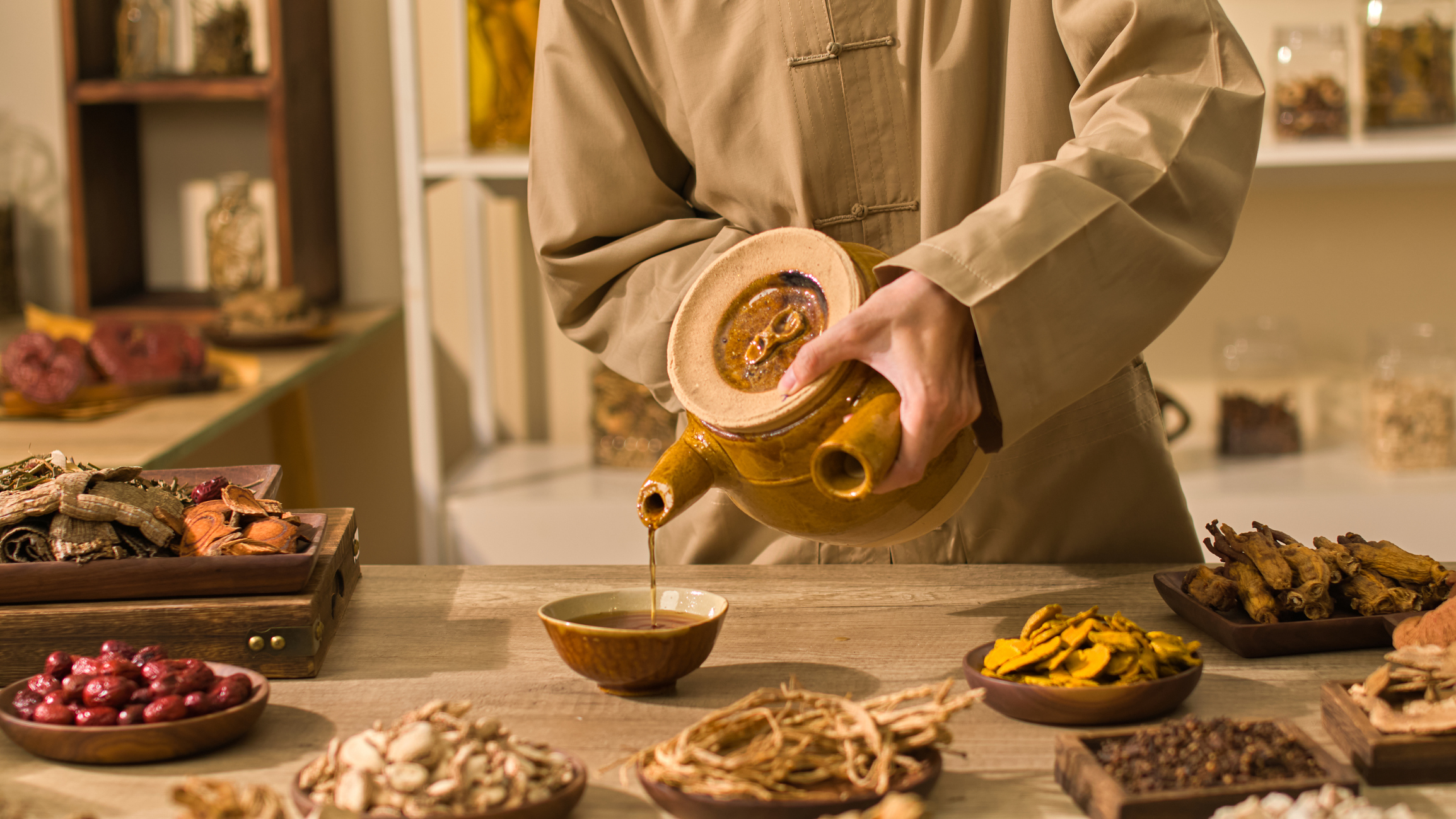
In TCM, we know that the Lungs hate dryness, though it’s also important not to allow for too much dampness or phlegm. Make sure to hydrate well, and choose moistening foods and herbs like pear, apple, tofu, tempeh, millet, white fungus, bai he (lily bulb), luo han guo (momordica fruit), mai men dong (ophiopogon tuber), sha shen (glehnia root), and tian men dong (asparagus root).
For those with too much phlegm and Dampness, it’s important to clear that out, so foods and herbs that can do that include garlic, onion, thyme, bai jie zi (white mustard seed), processed ban xia (pinellia rhizome), chuan bei mu or zhe bei mu (fritillaria bulb), dong gua ren (winter melon seed), gua luo (trichosanthes fruit or seed), sha ren (cardamom), and zhu ru (bamboo shavings). It is also best to avoid or limit dairy, greasy fried foods, and rich foods.
For those with weak Lung Qi, causing shortness of breath, tendency to get sick easily, fatigue, weak voice, and spontaneous sweating, herbs like huang qi (astragalus), dong chong xia cao (cordyceps), and ling zhi (reishi mushroom) can be helpful, as can the TCM formulas Bu Fei Tang (Tonify Lungs Decoction) or Yu Ping Feng San (Jade Windscreen Powder). But these are not the right prescriptions for someone who is currently sick.
Understandably, in any of the above patterns related to the Lungs, quitting smoking and vaping are highly suggested. Deep breath practice, skin brushing, ensuring proper bowel function, addressing sadness and grief, and letting go of those things that are no longer serving are also particularly helpful for the Lungs.
Case study
Sara is a 34-year-old health-conscious woman who came in for post-pneumonia treatment in early March. Her infection was diagnosed as pneumonia in mid-February, though she was not tested for COVID-19. The initial symptoms were a deep, chesty, hacking cough with yellow phlegm, fever and chills, and exhaustion.
She rested, was treated with antibiotics, and took an herbal antiviral formula, vitamin C, vitamin D, and zinc. After a few days, the fever cleared, the cough subsided, and the yellow phlegm turned clear and became difficult to cough up. She could still feel the phlegm, however, and was unable to take a deep breath because of a sensation of tightness in her chest. The fatigue and lingering shortness of breath meant she could no longer resume her running exercises, and even going up one flight of stairs was difficult. She was also feeling stressed about trying to catch up at work, and her sleep was affected because she felt she couldn’t get enough oxygen.
Sara is a natural health professional who is vegan, eats very healthily, and exercises regularly. She had started taking 1000mg of NAC daily on top of her regular supplements but was frustrated with the lasting effects of the lung infection.
Her usual tendency for TCM pattern of imbalance was toward Spleen Qi deficiency, with a tendency to overthink and worry, loose stools when stressed, fatigue, and foggy headedness.
Her TCM diagnosis was post-infection Lung Qi deficiency, Spleen Qi deficiency, and Phlegm-Damp obstruction in the Lungs. I chose the acupuncture points ST36, ST40, SP9, KI6, LU5, LU7, and REN17 and prescribed her a modified version of Er Chen Tang. Because she was already taking a number of supplements, including antivirals and ones to support her lung health, I focused on clearing the Phelgm.
After the acupuncture, the chest tightness cleared up, though she continued to keep with only light exercise. After a couple of days of taking the herbs, she noticed she cough up the phlegm 20 to 30 minutes after taking each dose, and her sleep normalized again. After a few weeks of herbal formula and one more session of acupuncture, the phlegm cleared, and I did not see her again until late August when smoke from fires was causing very poor air quality. She occasionally felt a burning sensation in her lungs, even when the air was clear, if she exercised strenuously.
In addition to acupuncture of ST36, SP6, KI6, LU1, LU7, LIV2, REN17, and Yintang, I recommended she start taking 1-2 mg of dong chong xia cao (cordyceps) daily, and while she continues to need to rehabilitate her lungs, she has been able to resume her exercising and daily activities fully.
References
Fields, H. (2015). The Gut: Where Bacteria and the Immune System Meet. John Hopkins Medicine. Retrieved from: https://www.hopkinsmedicine.org/research/advancements-in-research/fundamentals/in-depth/the-gut-where-bacteria-and-immune-system-meet
Kuenzig, E., Barnabe, C., Seow, C., Eksteen, B., Negron, M. (2017). Asthma is Associated with Subsequent Development of Inflammatory Bowel Disease: A Population-based Case-control Study. Clinical Gastroenterology and Hepatology. Retrieved from: https://www.sciencedirect.com/science/article/pii/S1542356517303208?showall%3Dtrue%26via%3Dihub
Shadmehr, D., Mitsuru, M., Michael, H., and Raphael, K. (2009) Skin-Derived TSLP Triggers Progression from Epidermal-Barrier Defects to Asthma. PLOS Biology. Retrieved from: https://journals.plos.org/plosbiology/article?id=10.1371/journal.pbio.1000067
About the Author: CJ Weber

Also on Integrative Practitioner

Dental Danger: Signs of Sleep Breathing Disorders in children and Adults, Learn the Visual Clues
Non-Member Price: $30.00 Member Price: $18.00 – 40% Off for Members Only Add to Cart Presented by: Mark Breiner, DDS,...

Integrative and Comprehensive Approach to Inflammatory Bowel Disease
Non-Member Price: $30.00 Member Price: $18.00 – 40% Off for Members Only Add to Cart Presented by: Ronald Hoffman, MD,...

Measuring Biology vs. Symptomatology: The Fully Integrated Functional Wellness Program
Non-Member Price: $30.00 Member Price: $18.00 – 40% Off for Members Only Add to Cart Presented by: Dane Donohue, DC...

Change Your Genes, Change Your Life
Non-Member Price: $30.00 Member Price: $18.00 – 40% Off for Members Only Add to Cart Presented by: Kenneth Pelletier, PhD,...
Guided Imagery – Efficacious, Portable, Scalable, User-Friendly, Self-Administered
Non-Member Price: $30.00 Member Price: $18.00 – 40% Off for Members Only Add to Cart Presented by: Belleruth Naparstek, ACSW...