







Traditional Chinese Medicine herbs and formulas to treat pain
Photo Cred: Miguel Á. Padriñán/Pexels
By Melissa Carr, BSc, DrTCM
Pain is an extensive topic, with a seemingly unlimited range of causes. However, one thing that acute, chronic, musculoskeletal, digestive, neurological, and other types of pains have in common in Traditional Chinese Medicine (TCM) is “Qi stagnation.”
There is a quote in TCM, “If there is free flow, there is no pain; if there is no free flow, there is pain.” Qi is often loosely translated as “life force” or “energy,” and it forms the foundation for much of TCM’s interpretation of how we work and how we fail. From a quantum physics narrative, Qi might be thought of as the charge and spin of atoms. Qi is what allows us to live, and for that matter, to exist. If Qi is obstructed, such as by an injury or illness, circulation is impaired and that limits our ability to heal. Thus, the starting point for treating any kind of pain is to move Qi and remove the obstruction.
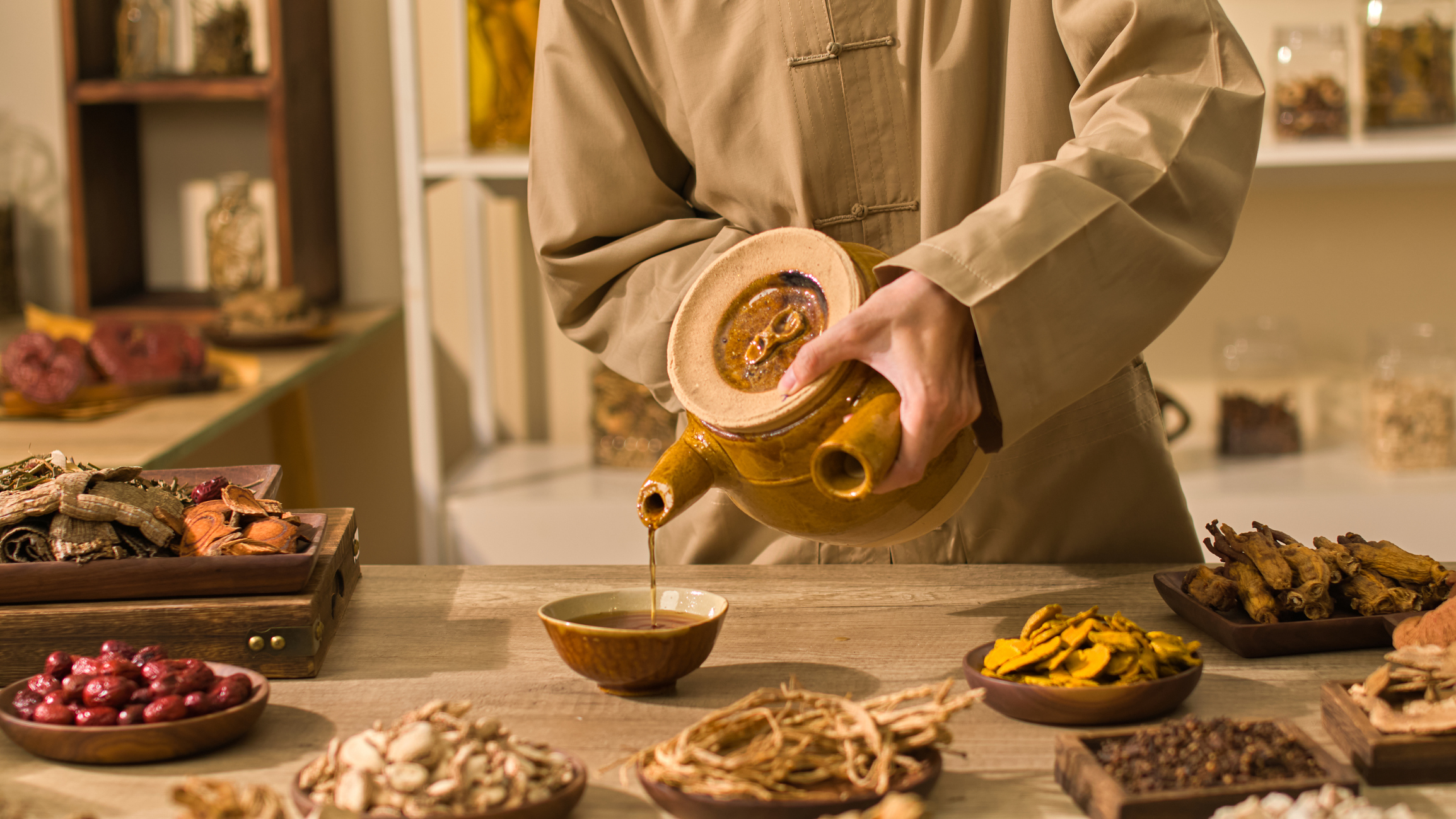
Though many thinking of TCM consider acupuncture as the lead treatment for managing pain, there is a long history of the effectiveness for Chinese herbs to treat pain. With physical distancing measures currently in place, acupuncture treatment is out of the question for many, so these herbal remedies become especially valuable.
Pain is a common experience for many people, and there are several herbal formulas as there are types of pain. Chinese herbal formulas often contain a dozen or more herbs, but the ones to be discussed here contain two herbs each.
While TCM practitioners prescribe Chinese herbal formulas based on the individual patient’s TCM diagnosis, derived through asking questions, observation, palpation, medical history, and family history, these formulas are often modified with the addition of other herbs, depending on the patient.
Jin Ling Zi San
This simple formula is made up of yan hu suo (Rz. Corydalis) and chuan lian zi (Fr. Toosendan). The formula is used to treat Liver Qi stagnation that has turned to Heat. It is used to treat intermittent pain in the chest, epigastric, and hypogastric areas, as well as hernia pain, abdominal masses, and dysmenorrhea. Symptoms that best indicate this formula’s use also include a bitter taste in the mouth, irritability, and a red tongue with yellow coat.
It is sometimes called a “TCM painkiller” and may be used in combination with other herbs to address the specific TCM diagnosis and syndrome, allowing it to treat a broader range of pains.
Yan hu suo is often employed in Chinese herbal formulas to decrease pain, and it has a growing body of research to back that up, with results indicating a dose-related analgesic effect to mitigate acute, inflammatory, and neuropathic pain, without causing tolerance. This herb is in the TCM materia medica category “herbs that invigorate Blood.” Blood stagnation pain tends to be severe, fixed, and sharp, and often worse at night. It may also be paired with masses, fibroids, and cysts.
Chuan lian zi (also called jin ling zi) is an “herb that regulates Qi.” It has been shown to decrease pain sensitivity. Qi stagnation pain may be dull and aching.
Shao Yao Gan Cao Tang
This formula of bai shao (Rx. Paeoniae alba) and zhi gan cao (Rx. Glycyrrhizae preparata) is categorized with “formulas that tonify the Blood.” It soothes the Liver, nourishes the Blood and Yin, moderates painful spasms, supports the Middle Jiao (digestive organs of Spleen/pancreas and Stomach), and relieves pain.
The TCM Liver helps regulate body cycles, relates to the sinews and tendons, stores the Blood, affects the primary digestive organs, and, when imbalanced, may be affected by Wind, causing spasms and cramps. The first herb, bai shao (also called bai shao yao or shao yao), is said to soothe and nourish the Blood. Zhi gan cao (honey-fried licorice root) supports the Middle Jiao.
This formula is often included if there is muscle cramping, whether in the calves, hands, gallbladder, uterus, bronchi, or intestines. It might also be added to other formulas to treat intercostal neuralgia, trigeminal neuralgia, sciatica, primary dysmenorrhea, and chronic pelvic inflammatory disease. Since it also supports the Middle Jiao digestive system, it could be included in the treatment of cramping pain from irritable bowel syndrome or some forms of inflammatory bowel disease.
Shi Xiao San
“Sudden Smile Powder” is this formula’s translation, and it contains wu ling zhi (Excrementum Trogopteri) and pu huang (Pollen Typhae). It is classified as “formulas that invigorate Blood and dispel Blood stasis.”
The name of the formula comes from that it was originally prescribed for those with post-partum epigastric and abdominal pain. After taking it, the pain disappears so quickly that the patient suddenly smiles.
To note, in my first year of TCM studies, I sprained my ankle and was prescribed a formula that contained, amongst other herbs, wu ling zhi (flying squirrel feces) and di long (earthworm). Along with acupuncture treatment, it resulted in a lower leg and foot that recovered to a state better, with no pain nor instability, than it had been prior to what was my second sprain of that ankle.
Wu ling zhi is an herb that invigorates Blood and removes Blood stasis. Pu huang (cattail pollen) stops bleeding. Together, these herbs treat irregular menstruation, dysmenorrhea, retention of the lochia, post-partum abdominal pain, severe pain in the abdomen, and endometriosis. It may also be included in the treatment of coronary artery disease, and herbs like chuan xiong, dan shen, and hong hua might be included for angina pectoris. Note, it should not be used during pregnancy.
A short list of possible TCM herbs to treat pain include mo yao (Myrrha), ru xiang (Gummi Olibanum), xiang fu (Rz. Cyperi rotundi), zhi ke (Fr. Citri seu ponciri), qin jiao (Rx. Gentianae qinjiao), qiang huo (Rz. et Rz. Notopterygii), wu yao (Rx. Liderae strychnifoliae), and the now widely recognized anti-inflammatory herb turmeric root (called jiang huang and yu jin).
In addition, if the pain is chronic, there is a high likelihood that the patient is also suffering from deficiencies of Qi or Blood, so that must also be addressed.
References
Bensky, D., Barolet, R. Chinese Herbal Medicine: Formulas & Strategies, 1990.
Takao, Y., Takaoka, Y. (2015). Shakuyaku-kanzo-to (Shao-Yao-Gan-Cao-Tang) as Treatment of Painful Muscle Cramps in Patients with Lumbar Spinal Stenosis and Its Minimum Effective Dose. Kobe J. Med. Sci. Retrieved from: http://www.lib.kobe-u.ac.jp/repository/81009388.pdf
Wang, L., Zhang, Y. (2016). The Antinociceptive Properties of the Corydalis yanhusuo Extract. PloS one. Retrieved from: https://www.ncbi.nlm.nih.gov/pmc/articles/PMC5021270/.
Xie, F., Zhang, M. (2008). Anti-inflammatory and analgesic activities of ethanolic extract and two limonoids from Melia toosendan fruit. Journal of Ethnopharmacology. Retrieved from: https://www.sciencedirect.com/science/article/abs/pii/S0378874108001104
Yuan, C-S., Mehendale, S.R. (2013). Effects of Corydalis yanhusuo and Angelicae dahuricae on Cold Pressor‐Induced Pain in Humans: A Controlled Trial. The Journal of Clinical Pharmacology. Retrieved from: https://accp1.onlinelibrary.wiley.com/doi/abs/10.1177/0091270004267809.
About the Author: CJ Weber

Also on Integrative Practitioner

Measuring Biology vs. Symptomatology: The Fully Integrated Functional Wellness Program
Non-Member Price: $30.00 Member Price: $18.00 – 40% Off for Members Only Add to Cart Presented by: Dane Donohue, DC...

Integrative and Comprehensive Approach to Inflammatory Bowel Disease
Non-Member Price: $30.00 Member Price: $18.00 – 40% Off for Members Only Add to Cart Presented by: Ronald Hoffman, MD,...

Dental Danger: Signs of Sleep Breathing Disorders in children and Adults, Learn the Visual Clues
Non-Member Price: $30.00 Member Price: $18.00 – 40% Off for Members Only Add to Cart Presented by: Mark Breiner, DDS,...

Dietary Needs of the Cognitively Impaired
Non-Member Price: $30.00 Member Price: $18.00 – 40% Off for Members Only Add to Cart Presented by: Laura Rokosz, PhD...

Lifestyle Choices Chart Your Brains Destiny
Non-Member Price: $30.00 Member Price: $18.00 – 40% Off for Members Only Add to Cart Presented by: David Perlmutter, MD,...