







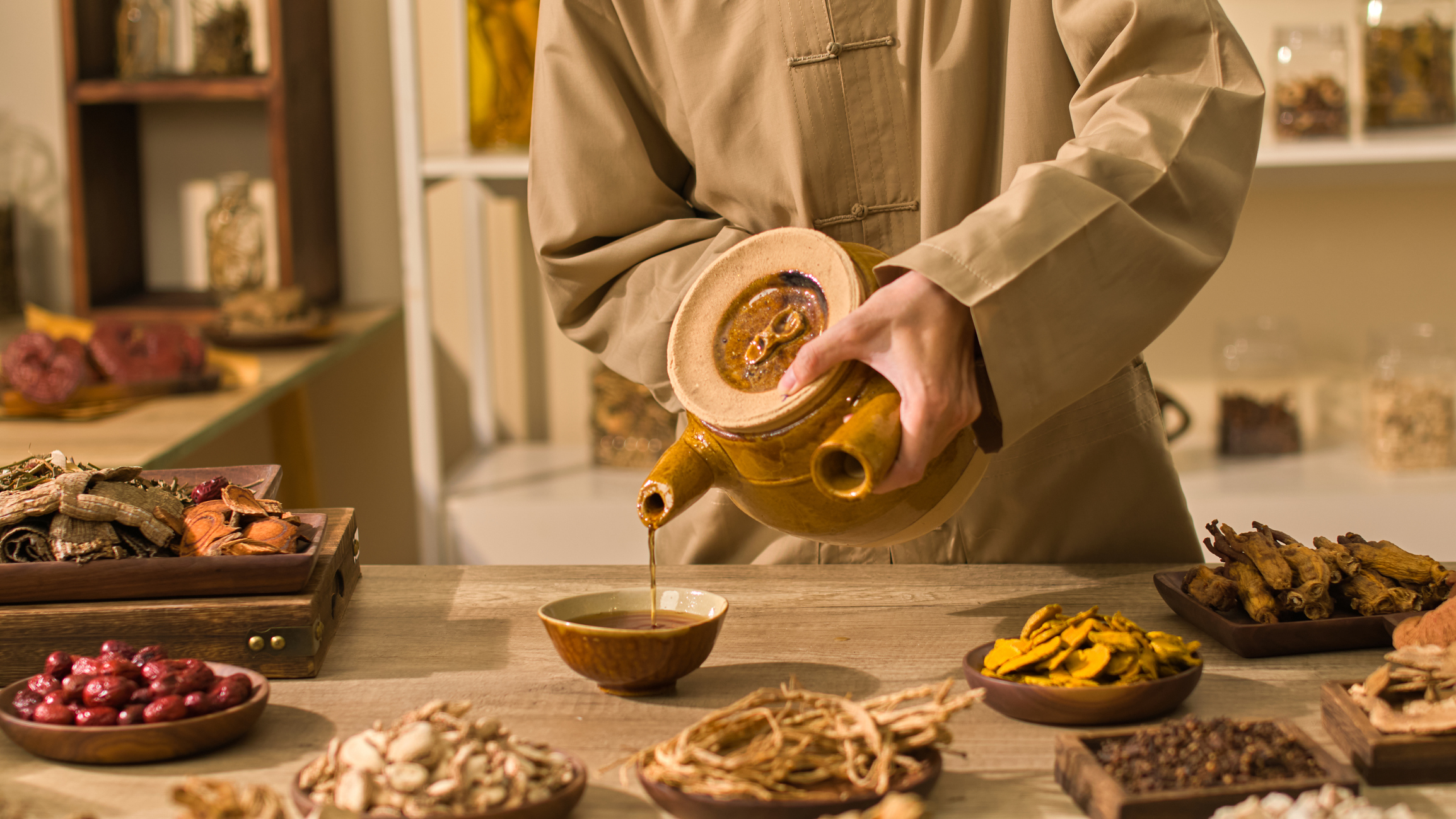


Traditional Chinese Medicine herbs for longevity
Photo Cred: Mareefe/Pexels
By Melissa Carr, BSc, DrTCM
My grandmother recently turned 100. While she doesn’t purport to have any special secrets for long life, she has followed some of the general healthy lifestyle recommendations for longevity, eating lots of vegetables, getting enough sleep, having hobbies, and being social. We do not yet know if there is a valid fountain of youth solution, but Traditional Chinese Medicine (TCM) has some excellent herbal options to consider.
Lifestyle recommendations are helpful and important to give to patients, but as integrative practitioners, we can only educate and encourage our patients to follow our suggestions. Thus, it’s helpful to have a few herbs up our sleeves to help with general health foundations. These are often classified in modern terminology as adaptogens and antioxidants, though in TCM they most fit in the Qi or Jing tonic categories.
Panax Ginseng
One of the most recognized herbs worldwide is ginseng, and it is both an antioxidant and an adaptogen. Its Chinese name is ren shen, meaning “man root.” There are a few forms of ginseng and they are not all the same.
The “true” ginseng that is most studied is Panax ginseng, also known as Chinese ginseng or Korean ginseng. Panax means “all healing,” indicating its wide range of health benefits. With more than 40 ginsenoside components being identified as its main active ingredients, it has been shown to have beneficial effects on cardiovascular diseases, regulation of blood sugars, though caution should be taken by those taking anti-diabetic drugs because of its compounding effect, management of allergic reactions, and potential in treating and preventing neurodegenerative disorders and cancer.
In TCM, it is classified as a Qi tonic, and though most Chinese herbs are prescribed in a compounded formula, ren shen is one of the rare herbs that may be prescribed on its own in the event of excess sweating or blood loss that leads to shortness of breath, shallow breathing, cold limbs, and an imperceptible pulse. It is often added to formulas to support chronic diarrhea, lethargy, wheezing, and shortness of breath.
One misconception is that ginseng is a stimulant. It is not and is often used to calm the nervous system for cases of anxiety, insomnia, restlessness, and palpitations. While I lived in Japan, before I knew anything about Chinese medicine, I was a research assistant at a medical university, and my professor and I published a paper about ginseng’s anxiolytic properties in the European Journal of Pharmacology.
It is not recommended for those with a lot of Heat signs like red face, hypertension, hot flashes, or yellow phlegm.
Reishi mushroom
If ren shen is the king, reishi mushroom might be considered the queen. Reishi mushroom—ling zhi in Chinese medicine—is sometimes referred to as “the herb of spiritual potency,” “the great protector,” and the “mushroom of immortality.” Reishi mushroom is classified in TCM as “nourishing the Heart and calming the Spirit,” but it is also a Qi and Blood tonic herb that acts as an adaptogenic, anti-inflammatory, and antioxidant.
Less of an emergency herb than ginseng, it is another herb sometimes used one its own in TCM. It can be employed solo or in combination for anxiety, insomnia, palpitations, forgetfulness, or cough and wheezing for some patients.
Reishi contains compounds called ganoderic acids, polysaccharides, and sterols, and it has been found to be immunomodulating, boosting immune response and having anti-tumor activity, while also helping balance an overactive immune system that results in autoimmune disorders and allergies. Studies have additionally shown that it can benefit the liver, heart and cardiovascular system, lungs, and kidneys.
The ancient Chinese emperors revered reishi mushrooms, placing images of it in their palaces, and its popularity is once again on the rise with the appearance of it in herbal mixtures, hot chocolate mixes, chocolate bars, and coffee blends.
Cordyceps
Cordyceps is another outstanding TCM herb. The Chinese name is dong chong xia cao, meaning “winter worm, summer herb.” This is because it affects the larvae of moths, killing them and taking over.
For those who can get over the idea of how this herb came into being, there may be some health benefits, especially for those looking to improve energy, athletic performance, and virility. TCM places this herb in the category to tonify Yang energy, treating low back and leg weakness and soreness as well as impotence. It is also used to improve asthma, chronic cough with wheezing, and a consumptive blood-streaked sputum cough.
It is rich in antioxidants, polysaccharides, and sterols, and it has been shown to inhibit the growth of some tumor cells.
Astragalus
Astragalus, known in TCM circles as huang qi, is the chief herb in several common TCM formulas, including Bu Zhong Yi Qi Tang, a Qi tonic that strongly boosts and lifts Qi, and Yu Ping Feng San, a formula to support the immune system to defend against colds and flus.
Astragalus has numerous pharmacological actions, including antioxidant, anti-inflammatory, anti-cancer, immunoregulating, hepatoprotective, and protecting against neurodegeneration and vascular damage and deterioration. One of its more interesting benefits is that research has shown it can help protect telomeres, safeguarding the ends of chromosomes from damage that contributes to aging-related diseases.
Food Herbs
While these highlighted herbs may receive much of the glory, and people are willing to shell out the big bucks to get their hands on them, several of TCM’s foods and medicinal herbs are interchangeable. In fact, many Chinese families pass down medicinal soup recipes that include herbs such as dang gui (angelica or dong quai), shan yao (Chinese wild yam), dang shen (codonoposis root), and bai he (dried lily bulbs).
Even more food-like and easily obtainable TCM herbs for the average North American are ginger (sheng jiang and gan jiang), turmeric (yu jin, jiang huang, and e zhu), garlic (da suan), dates (da zao and hong zao), cinnamon (gui zhi and rou gui), green tea (cha ye), scallions (cong bai), and goji berries (gou qi zi).
It’s difficult to avoid the often quoted “food is medicine” because the value of daily use of suitable food herbs can greatly outweigh the occasional or wrongly applied superstar longevity herb, but a mixture of both may help make healthy aging a much more accessible goal.
References
Bernardes de Jesus, B., Schneeberger, K. (2011). The telomerase activator TA-65 elongates short telomeres and increases health span of adult/old mice without increasing cancer incidence. Aging Cell. Retrieved from: https://onlinelibrary.wiley.com/doi/full/10.1111/j.1474-9726.2011.00700.x
Carr, M., Bekku, N., Yoshimura, H. (2006). Identification of anxiolytic ingredients in ginseng root using the elevated plus-maze test in mice. European Journal of Pharmacology. Retrieved from: https://www.sciencedirect.com/science/article/abs/pii/S0014299905013166
Chen, S., Li, Z., Krochmal, R. (2010). Effect of Cs-4® (Cordyceps sinesis) on Exercise Performance in Healthy Older Subjects: A Double-Blind, Placebo-Controlled Trial. The Journal of Alternative and Complementary Medicine. Retrieved from: https://www.liebertpub.com/doi/abs/10.1089/acm.2009.0226
Cherian, E., Sudheesh, N., Janardhanan, K. (2011). Free radical scavenging and mitochondrial antioxidant activities of Reishi-Ganoderma lucidum. Journal of Basic and Clinical Physiology and Pharmacology. Retrieved from: https://www.degruyter.com/view/j/jbcpp.2009.20.4/jbcpp.2009.20.4.289/jbcpp.2009.20.4.289.xml
Huang, S., Mao, J. (2017). Polysaccharides from Ganoderma lucidum Promote Cognitive Function and Neural Progenitor Proliferation in Mouse Model of Alzheimer’s Disease. Stem Cell Reports. Retrieved from: https://www.ncbi.nlm.nih.gov/pmc/articles/PMC5233449/
Ji, D., Ye, J., Li, C. (2008). Antiaging effect of Cordyceps sinesis extract. Phytotherapy Research. Retrieved from: https://onlinelibrary.wiley.com/doi/abs/10.1002/ptr.2576
Li, X., Zhang, Y., Kuang, H. (2012). Mitochondrial Protection and Anti-aging Activity of Astragalus Polysaccharides and Their Potential Mechanism. International Journal of Molecular Science. Retrieved from https://www.mdpi.com/1422-0067/13/2/1747
Liu, P., Zhao, H., Luo, Y. (2017). Anti-Aging Implications of Astragalus Membranaceus (Huangqi): A Well-Known Chinese Tonic. Aging and Disease. Retrieved from: https://www.ncbi.nlm.nih.gov/pmc/articles/PMC5758356/#__ffn_sectitle
Xin, C., Wang, S., Nie, S. (2013). Properties of Cordyceps Sinesis: A review. Journal of Functional Foods. Retrieved from: https://www.sciencedirect.com/science/article/pii/S1756464613000522#!
About the Author: CJ Weber

Also on Integrative Practitioner

Dental Danger: Signs of Sleep Breathing Disorders in children and Adults, Learn the Visual Clues
Non-Member Price: $30.00 Member Price: $18.00 – 40% Off for Members Only Add to Cart Presented by: Mark Breiner, DDS,...

Integrative and Comprehensive Approach to Inflammatory Bowel Disease
Non-Member Price: $30.00 Member Price: $18.00 – 40% Off for Members Only Add to Cart Presented by: Ronald Hoffman, MD,...

Measuring Biology vs. Symptomatology: The Fully Integrated Functional Wellness Program
Non-Member Price: $30.00 Member Price: $18.00 – 40% Off for Members Only Add to Cart Presented by: Dane Donohue, DC...

Change Your Genes, Change Your Life
Non-Member Price: $30.00 Member Price: $18.00 – 40% Off for Members Only Add to Cart Presented by: Kenneth Pelletier, PhD,...

Guided Imagery – Efficacious, Portable, Scalable, User-Friendly, Self-Administered
Non-Member Price: $30.00 Member Price: $18.00 – 40% Off for Members Only Add to Cart Presented by: Belleruth Naparstek, ACSW...