



Manual therapies for upper respiratory infection
Photo Cred: Pixabay
By Bill Reddy, LAc, DiplAc
There are countless techniques passed down through the millennia currently taught in Traditional Chinese Medicine (TCM) programs, in medical schools in China, and through Taoist philosophy oral traditions. While there are many descriptions for point prescriptions and herbal remedies for upper respiratory infections (URI’s), this paper will focus on manual therapies, specifically cupping, topical application of liniments, gua sha, and tui na.
As TCM predates the invention of the microscope by more than 2,000 years, the ancient Chinese doctors were not aware of the concept of microorganisms, but recognized that those with compromised immune systems (anti-pathogenic Qi) were more likely to contract an illness such as cold or flu. They characterized pathogens as xia Qi, malicious energy or evil Qi, or wind that would enter the body through the mouth or nose, or skin and pores, and lead to the symptoms of disease.
TCM further differentiates URI’s into “invasion of wind heat” and “invasion of wind cold.” The earliest differentiation of wind heat and wind cold came from the Shang Han Lun by Zhang Zhong (AD 220), although the emphasis was on cold syndromes at that time. Wind heat is characterized by sore throat, coughing, fever, body aches, headache, nasal congestion with thick yellow or green sputum, constipation, and a thick, yellow coating on the tongue. Invasion of wind cold is characterized by fever or chills, aversion to wind/cold, headache, body aches, rhinorrhea with thin clear or yellow discharge, and a thick white tongue coating.
Cupping is typically applied to acupoints on the upper back and neck, which include Dazhui (Governor’s Vessel 14), Fengmen (BL 12), Feishu (BL 13), Xinshu (BL 15) and Geshu (BL 16).
Cups can be made from glass, silicone, earthenware, or bamboo with diameters ranging as small as a half inch to as large as three inches. The common diameter range for this purpose is two to three inches. It is common to retain the cups for 10 minutes, but in the case of cold or flu, increasing the duration to 20 to 25 minutes is more effective.
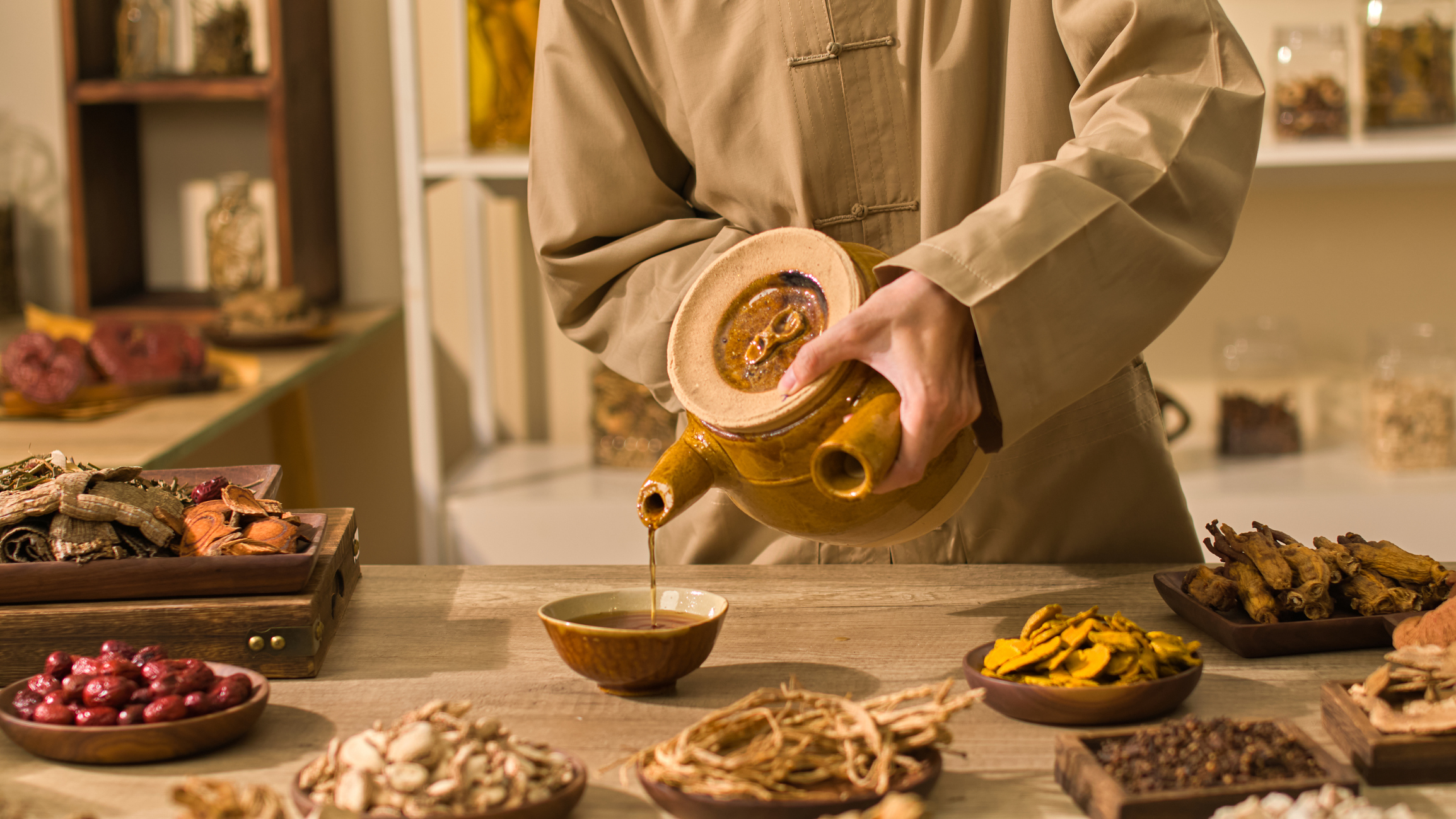
Traditional Chinese herbal medicine cannot only be ingested but can be used topically as liniments and poultices. The use of essential oils was first documented between 2697 and 2597 B.C. during the reign of Huang Ti, the Yellow Emperor. Mint (Bo He) has been used internally to treat common cold symptoms such as fever, cough, headache, sore throat, and red eyes. Mint is spicy, aromatic, and cool and enters the Lung and Liver channels. It’s known to “release the exterior” when applied to wind heat conditions.
Essential oils are so concentrated that one drop of mint oil is equivalent to 27 cups of mint tea. Mixed with a “carrier oil” such as coconut or olive oil, or “neat,” it can be applied to the forehead, temples, soles of the feet, and acupoints such as LI4 (Hegu) and LU7 (Lie Que) to relieve sinus pressure and headache.
By contrast, cinnamon (Gui Zhi) is very warming. It can be used similarly to the above, but in wind cold conditions.
Gua sha (literally translating to “scraping” or “scrape red”) is a common technique used in TCM. Traditional Gua Sha tools include spoons, coins, and flat or curved tools made from natural substances such as animal horns and jade. It increases microcirculation and stimulates the production of pro-inflammatory cytokines while decreasing immunosuppressive cytokines.
To treat cold and flu symptoms, the technique involves lubricating the back with an appropriate oil or liniment and scraping diagonally from the spine laterally and inferiorly across the back. Because the goal of any treatment is to bring the body back to homeostasis, cooling liniments (such as White Flower oil) are applied for wind heat conditions and warming liniments (such as Po Sum On oil) are applied for wind cold conditions.
Scraping up and down bilaterally at B13 is typically performed to treat cough. Since there is commonly lymphatic congestion in the neck and head during cold and flu, using the gua sha tool to gently stroke down the circumference of the neck, especially along the sternocleidomastoid muscle, can help ease the sense of pressure in the sinuses and of a stiff neck. Scraping around the base of the occiput, GV 17/18 area and laterally, can further relieve sinus congestion.
To help promote Eustachian tube drainage, a common manual technique involves rubbing the palms briskly together (with the fingers not touching, just the palms) until warm, then placing them flat and firmly over the patient’s ears. The practitioner then pulls their hands apart (like a reverse clap), causing the pressure in the ears to release. The patient often feels a gentle “pop” as the sense of fullness or crackling diminishes.
A tui na technique for a cough involves boiling water with a liniment containing menthol, though Vicks vaporub is a viable alternative. After boiling, the practitioner removes the water from the heat source and adds the liniment. They then place a towel over the head of the patient and have them breathe deeply for a few minutes. The practitioner places the patient prone or face down on a horizontal incline with their head lower than their legs. The practitioner cups his or her hands and percusses them up and down along the patient’s lungs, like playing bongos. This loosens the phlegm in their lungs for them to expectorate.
References
Chen, T., Liu, N., Liu, J., Zhang, X., Huang, Z., and Zang, Y. (2016) Gua Sha, a press-stroke treatment of the skin, boosts the immune response to intradermal vaccination. Peer J. Retrieved from: https://www.ncbi.nlm.nih.gov/pubmed/27672506
Ye, X.F., Zhang, H.F., and Pang, Z.W. (2011) Therapeutic effects of common cold of wind-cold type at early stage treated by different cupping duration. Zhongguo Zhen Jiu. Retrieved from: https://www.ncbi.nlm.nih.gov/pubmed/21528605
About the Author: CJ Weber

Also on Integrative Practitioner

Dental Danger: Signs of Sleep Breathing Disorders in children and Adults, Learn the Visual Clues
Non-Member Price: $30.00 Member Price: $18.00 – 40% Off for Members Only Add to Cart Presented by: Mark Breiner, DDS,...

Integrative and Comprehensive Approach to Inflammatory Bowel Disease
Non-Member Price: $30.00 Member Price: $18.00 – 40% Off for Members Only Add to Cart Presented by: Ronald Hoffman, MD,...
Measuring Biology vs. Symptomatology: The Fully Integrated Functional Wellness Program
Non-Member Price: $30.00 Member Price: $18.00 – 40% Off for Members Only Add to Cart Presented by: Dane Donohue, DC...

Change Your Genes, Change Your Life
Non-Member Price: $30.00 Member Price: $18.00 – 40% Off for Members Only Add to Cart Presented by: Kenneth Pelletier, PhD,...
Guided Imagery – Efficacious, Portable, Scalable, User-Friendly, Self-Administered
Non-Member Price: $30.00 Member Price: $18.00 – 40% Off for Members Only Add to Cart Presented by: Belleruth Naparstek, ACSW...